How long can your garage stay empty for a floor project?
No votes yet. Yours will be the first. · saved on this device
Loading...

Garage Floor Brief · Planning quiz
This eight-question quiz tests what you know about garage floor systems and, in the process, surfaces the constraints that decide the choice: how long the garage can be empty, whether the slab has moisture, how hot the tires get, and what loads the floor will carry. Each answer explains the reasoning with a sourced figure so the result is something you can defend at a site visit.
Start the quiz0 of 8 answered
Homeowners tend to choose a garage floor by look first and discover the constraints later. The questions below reverse that order. They are framed as knowledge questions because the facts behind them, cure times, failure modes, moisture limits, are what a good proposal is built on. Score yourself, read the explanations, and then use the comparisons or the calculator to go further.
Four things. First, whether you know how long each system keeps cars out, since Garage Living puts epoxy at up to 7 days and polyaspartic at 24 hours, and that single fact decides many projects. Second, whether you understand why coatings fail, which is preparation and moisture rather than chemistry. Third, whether you know what tiles can and cannot carry. Fourth, whether you have a realistic budget: Duration's two-car range of $1,600–$6,900 is wide for reasons the quiz explains.
If most of your answers were right, you are ready to read proposals critically; go to the service pages for the checklists and the request form for estimates. If several were wrong in the same area, that is the section to read before a site visit. Missing the cure-time questions means you should settle the downtime constraint before choosing a chemistry; missing the moisture questions means you should insist on a test with a number before signing anything.
The quiz does not know your slab. A result that favors a coating is conditional on a passed moisture test and a sound surface, both of which come from the site visit. Treat it as a way to organize your preferences, not as a diagnosis. The polls show how other visitors weighed the same trade-offs.
The wrong answers in this quiz are not random; they are the assumptions that produce failed floors. Believing epoxy is drivable the next day leads to tire marks in soft coating. Believing a thicker coat beats moisture leads to blisters by spring. Believing acid etching is preparation leads to the 1–3 years lifespan Bob Vila assigns to water-based kits. Believing rollover weight is the only tile limit leads to a cracked tile under the first jack stand. Each is cheap to learn here and expensive to learn in the garage.
There is also a budget assumption worth testing. Homeowners who expect a coated two-car garage to cost under $1,000 are anchored on kit prices; those who expect $10,000 are anchored on showroom floors. Duration's two-car range, Angi's $1,500–$6,000 for a 500-square-foot garage, and Bob Vila's $2,441 average put the realistic center in view before the first proposal arrives, which makes the proposals easier to judge.
Every explanation cites a published source: Duration Concrete Coatings' 2026 cost guide, Bob Vila's 2024 guides, Garage Living's 2026 comparison, Garage Flooring LLC's 2025 comparison, Swisstrax product specifications, Hello Garage on hot tire pickup, NAHB's analysis of Census data, and the site's own analysis of the EIA's 2024 household survey, which finds 42.9% of occupied homes have an attached garage and 27.8% a two-car attached garage. Where an installer published the figure, the explanation says so, and the same figures appear with links on the service pages and in the site's statistics.
Homeowner polls
No votes yet. Yours will be the first. · saved on this device
No votes yet. Yours will be the first. · saved on this device
No. It tells you which constraints you have and whether your understanding of the systems matches the published facts. The result points to a system whose trade-offs fit, but the moisture reading and slab condition from a site visit make the final call.
Then settle the downtime question first. If cars must be inside within a day, epoxy is effectively off the table unless you have somewhere else to park for a week. That single constraint narrows the choice to polyaspartic or tiles before price enters.
It is the most important one to understand. Moisture from below is the failure a coating cannot outlast, and it is invisible on a dry summer day. Read the preparation page and insist on a calcium chloride or relative humidity test with a number before any coating proposal is accepted.
Yes, as often as you like. Retaking it after reading the service pages is a reasonable way to check that the explanations landed. Nothing is stored or scored beyond your browser session.
Because preferences are easy and facts are what proposals are built on. A homeowner who knows the cure times, the prep method, and the moisture limit can read any proposal critically. A preference quiz would tell you what you already want.
It means you understand the trade-offs, which is a good start. The pro-versus-DIY comparison covers where DIY makes sense; the short version is that tiles are a reasonable owner install and coatings usually are not, because grinding is the value.
Each explanation names its source, and the same figures appear on the service pages with links to the original publisher. The site keeps every statistic attributed so you can read the source yourself rather than trust a summary.
 Free toolGarage floor cost calculator
Size, material tier and complexity in, a realistic budget range out.
 Free toolGarage floor comparisons
Side-by-side tables for the decisions that change the price most.
 Free toolGarage floor polls: how other homeowners decided
See what other planners chose and add your vote.
 Service guideEpoxy Garage Floor Coating
An epoxy garage floor coating is a two-part resin system applied in layers over ground, repaired concrete.
 Service guidePolyaspartic Floor Coating
A polyaspartic floor coating is an aliphatic polyurea system that cures within hours, resists UV yellowing, and tolerates lower application temperatures than epoxy.
 Service guideInterlocking Garage Tiles
Interlocking garage tiles are rigid or flexible modular pieces, usually 12 to 16 inches square, that snap together over the existing concrete without adhesive or curing.
 Service guideConcrete Grinding & Prep
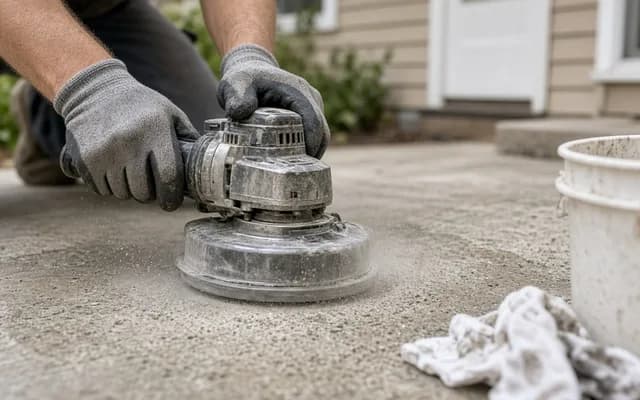
Concrete grinding and preparation means mechanically profiling a garage slab, removing old coatings and contamination, repairing cracks and spalls, and testing moisture so that a bonded coating can adhere.
Tell us the size, the condition of what is there now, and what you want to change. Garage Floor Brief passes your request to independent local professionals, who reply with written, no-obligation estimates. The service is free to use.