What condition is your slab in?
No votes yet. Yours will be the first. · saved on this device
Loading...
Garage Floor Brief · Service guide
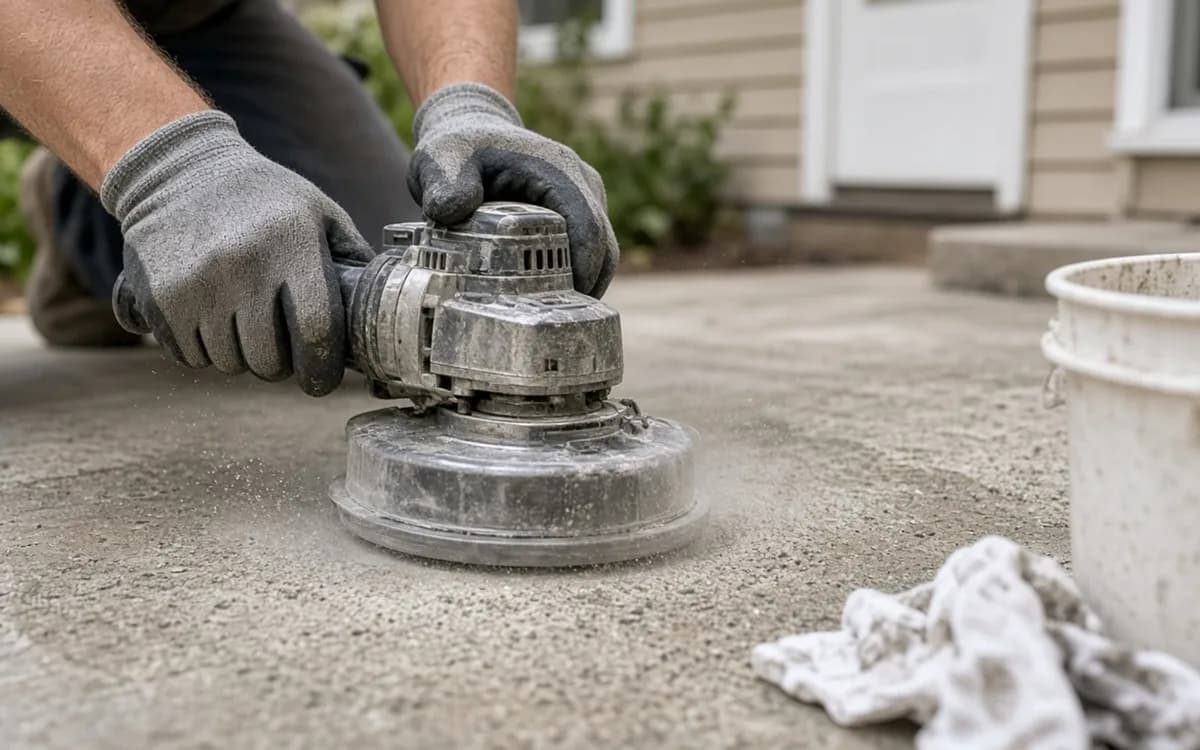
Concrete grinding and preparation means mechanically profiling a garage slab, removing old coatings and contamination, repairing cracks and spalls, and testing moisture so that a bonded coating can adhere. It is required for any epoxy or polyaspartic floor and is also sold on its own as a grind-and-seal finish or as removal of a failed coating. Expect $1 to $5 per square foot for grinding alone.
Every peeled garage floor has a preparation story behind it. The coating was rolled over a sealer nobody found, or over acid-etched concrete with the salts still in it, or over a slab that was pushing moisture upward the whole time. Angi's 2026 epoxy guide attributes 33–60% of the installed price to labor, and that labor is preparation far more than it is rolling resin.
This page explains what proper prep includes, what it costs as line items, how the result is verified, and when grinding is a finished floor by itself. If you are still choosing between a coating and tiles, note that only the coating needs any of this; tiles sit on a swept slab.
Want the numbers only? Read the concrete grinding & prep cost guide for 2026 ranges, what moves the price, and sample budgets.
| Item | Low | High | Unit | Notes |
|---|---|---|---|---|
| Diamond grinding and profiling | $1 | $5 | per sq ft | Duration 2026 |
| Removal of an existing coating | $3 | $8 | per sq ft | Duration 2026 |
| Crack chasing and rigid fill | $250 | $800 | flat | Duration 2026; per garage |
| Moisture testing (calcium chloride or RH probe) | $200 | $500 | flat | Duration 2026 |
| Moisture-mitigating primer | $0.5 | $1 | per sq ft | Bob Vila 2024 lists barrier at up to $1 |
| Grind-and-seal finished floor | $2 | $6 | per sq ft | Grinding plus densifier and sealer |
Three situations. First, you have a failed coating and want it gone before deciding what comes next; Duration prices old-coating removal at $3 to $8 per square foot, which is often more than the new coating's resin. Second, you want a bare, ground, sealed concrete floor as the finish, a durable and inexpensive choice for a workshop where looks are secondary. Third, you want an independent read on whether the slab is coatable at all, with a moisture test and a surface assessment, before you pay for a system.
In most coating projects, prep is bundled into the epoxy or polyaspartic proposal by the same installer. That is fine as long as it is itemized. A proposal that lists a single per-square-foot price for the finished floor makes it impossible to see whether grinding, repairs, and moisture work are real line items or assumptions that will surface as change orders on day one.
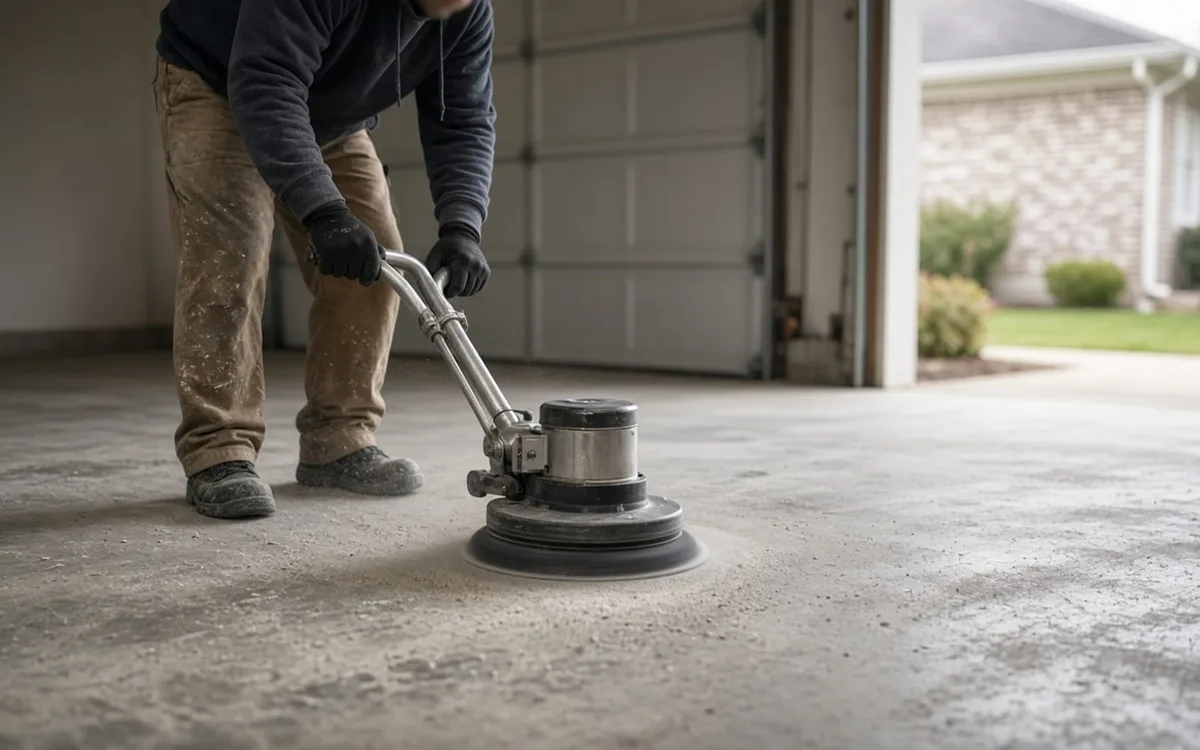
Diamond grinding is the standard. A walk-behind planetary grinder with metal-bond diamonds and a dust extractor removes the weak top layer of paste, opens the pores, and leaves a measurable texture. Coating manufacturers specify that texture as a concrete surface profile, and most garage coatings want CSP 2 to 3, a fine sandpaper feel. Shot blasting is used for heavier removal and produces a rougher profile; it is more common in commercial work. Acid etching, the DIY-kit method, is not accepted by most professional coating data sheets.
After grinding, cracks are chased with a crack saw or V-groove blade, vacuumed, and filled with a rigid polyurea or epoxy filler that can be ground flush. Spalls and pop-outs get a patching mortar. Oil-soaked spots are degreased, sometimes repeatedly, then reground; contamination that has soaked deep may need a primer specifically rated for it. Control joints are either filled flush for a seamless look or honored with a flexible sealant, and the choice should be in the proposal because it changes how the floor looks and how it handles slab movement.
Cleveland Concrete Coatings, an Ohio installer, lays the job out in six steps, grinds to CSP-2 to CSP-3 and removes the top 1 to 3 mils of concrete, and puts grinding plus crack repair on a standard two-car garage at three to four hours. The numbered sequence in this section follows that order, and it is the order to check a proposal against.
Concrete is porous, and a garage slab poured without a vapor retarder under it acts as a wick for ground moisture. A coating applied over that slab traps vapor until pressure lifts it off. The failures show up as blisters, then delamination, usually in the first wet season. The test is cheap by comparison: Duration lists moisture testing at $200 to $500, against a coated two-car garage priced at $1,600–$6,900.
The two accepted methods are a calcium chloride test, which measures vapor emission over 60 to 72 hours, and an in-slab relative humidity probe. Both produce a number, and coating manufacturers publish the maximum their product tolerates. A plastic sheet taped down overnight is a screen that can miss a borderline slab. If the number is over the limit, options are a moisture-mitigating epoxy primer, a breathable tile system, or fixing the drainage that is feeding the slab. What a coating cannot do is beat the physics with a thicker coat.
Duration's 2026 guide is the cleanest breakdown: surface preparation at $1–$5 per sq ft, minor crack repair at $250 to $800, moisture testing at $200 to $500, and old-coating removal at $3 to $8 per square foot. On a 450-square-foot two-car garage, that puts basic grinding at roughly $450 to $2,250, and a full removal of a failed coating at $1,350 to $3,600 before any new floor goes down.
The range within grinding depends on the concrete. A hard, smooth, broom-finished slab grinds quickly; a soft, dusting slab clogs diamonds and needs more passes; a slab with a thick previous coating or a curing compound needs aggressive tooling. Access matters too: a detached garage with a narrow door and no power for a 220-volt grinder costs more to prep. Angi lists epoxy labor at $1–$7 per sq ft, and prep is where most of that range lives. The calculator treats grinding, removal, crack repair, and moisture work as separate add-ons.
| Prep item | Typical cost | Two-car garage (450 sq ft) | Source |
|---|---|---|---|
| Grinding and profiling | $1–$5 per sq ft | $450–$2,250 | Duration 2026 |
| Old coating removal | $3–$8 per sq ft | $1,350–$3,600 | Duration 2026 |
| Minor crack repair | $250–$800 flat | $250–$800 | Duration 2026 |
| Moisture testing | $200–$500 flat | $200–$500 | Duration 2026 |
Ask how the installer will confirm the slab is ready, because ready is a set of measurable conditions. Profile is checked by comparison with ICRI concrete surface profile chips, or simply by the installer showing you the texture and naming the CSP target from the data sheet. Cleanliness is checked with a water drop: on clean, open concrete it soaks in within seconds; on a slab still carrying a sealer it beads. Moisture is a number from a test. Contamination is checked by regrinding a suspect spot and watching whether it darkens.
A serious installer will walk you across the ground slab before the primer goes on. That is the moment to look for shiny patches (sealer or curing compound not removed), dark patches (oil still present), and cracks that were skipped. Once the primer is down, none of that can be fixed without grinding again. Reading customer reviews for mentions of peeling within the first year tells you whether an installer takes this step seriously.
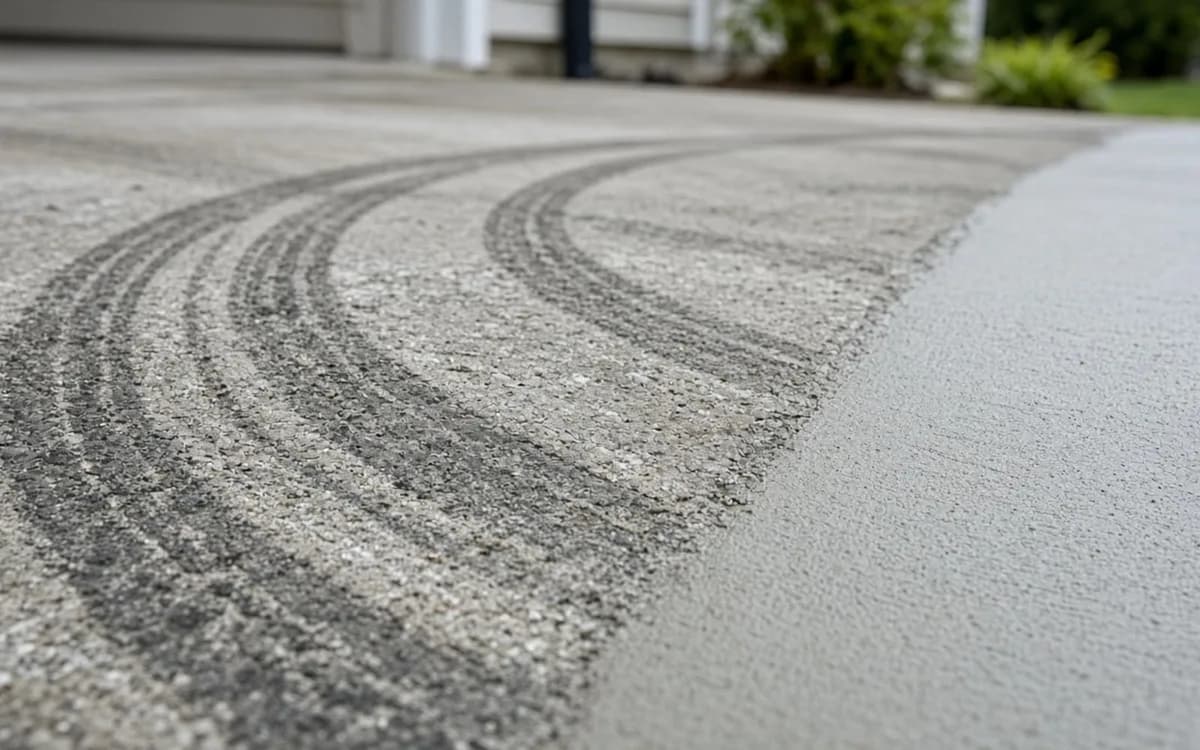
The expensive mistake is coating over something. Old sealers, curing compounds, and paint are invisible once a slab is swept, and a coating applied over them bonds to the sealer rather than the concrete. The second mistake is grinding without dust extraction, which leaves fine dust in the pores that acts as a bond breaker. The third is filling cracks with a flexible caulk that the coating cannot bridge, leaving a visible line that soon opens. The fourth is skipping the moisture test because the slab looked dry in August.
Each of those turns into removal, which Duration prices at $3 to $8 per square foot on top of a new coating. FloorTek's estimate that DIY kits fail within one to two years and under-prepared professional epoxy within 3–5 years is a preparation story, not a chemistry story. Hot tire pickup, the failure Hello Garage attributes to tire temperatures above 140°F, only lifts a coating that was not mechanically anchored in the first place.
Not every garage needs a coating. A ground slab treated with a lithium silicate densifier and a penetrating or thin-film sealer stops dusting, resists most stains for a while, and looks like clean, honest concrete. It costs roughly the grinding price plus a modest sealer line, and there is little film to peel. It will not hide patches or cracks, and oil left overnight can still stain. For a working shop, a rental, or a homeowner who dislikes the flake look, it is a reasonable endpoint. Ask for it as an option when you send the request so proposals include both paths.
Older Northeast and Midwest garages often have slabs poured without a vapor retarder and with decades of road salt worked in; moisture readings and chloride contamination are the surprises. Southern and Southwestern slabs tend to be drier but are more often finished with curing compounds that must be ground off. Our analysis of the EIA's 2024 household survey finds 32.4% of occupied homes sit over a concrete slab, 43.0% in the South versus 15.7% in the Northeast, and 53.0% of owner-occupied attached-garage homes report a slab foundation. That describes the house, not the garage floor, but it tracks with where slab moisture comes up. The locations page has more.
Garage Floor Brief ran these numbers on the federal government's own household data. You won't find them in a contractor's brochure.
Garage Floor Brief analysis · 2024
95% interval 51.8%–54.3% · about 27.5 million homes · 7,070 survey households
Just over half of homes with an attached garage report a concrete-slab foundation, the surface every coating or polish goes onto. Moisture testing that slab is the step that decides whether a floor lasts.
Source: Garage Floor Brief analysis of 2024 federal household survey data from the U.S. Energy Information Administration. How we calculated it
Homeowner polls
No votes yet. Yours will be the first. · saved on this device
No votes yet. Yours will be the first. · saved on this device
No votes yet. Yours will be the first. · saved on this device
 Service guideEpoxy Garage Floor Coating
An epoxy garage floor coating is a two-part resin system applied in layers over ground, repaired concrete.
 Service guidePolyaspartic Floor Coating
A polyaspartic floor coating is an aliphatic polyurea system that cures within hours, resists UV yellowing, and tolerates lower application temperatures than epoxy.
 Service guideInterlocking Garage Tiles
Interlocking garage tiles are rigid or flexible modular pieces, usually 12 to 16 inches square, that snap together over the existing concrete without adhesive or curing.
With a grinder connected to a HEPA dust extractor, very little escapes, but some fine dust still settles on shelves and in door tracks. Without extraction, the garage and everything in it is coated. Ask whether extraction is used and plan to cover or remove anything you care about. Silica dust is a health hazard, so a crew grinding dry without extraction is a warning sign.
Yes. Deep spalling, a slab that has heaved so joints have lips, or concrete that crumbles under the grinder points to a slab problem rather than a surface problem. An installer may recommend a self-leveling overlay before coating, a tile system that bridges the damage, or a concrete contractor's evaluation. A coating over failing concrete fails with it.
Laitance is a weak, chalky layer of cement paste and fines that rises to the surface when concrete is overworked or over-watered during finishing. It looks like solid concrete but has little strength, and a coating bonded to it peels off with it. Grinding removes it; acid etching does not reliably. Dusting when you sweep is the usual sign it is present.
It is a choice. Filling joints flush with a semi-rigid filler gives a seamless floor but can crack if the slab moves. Leaving joints as a flexible sealed line honors movement but shows as a stripe. Most residential garages with a stable slab get the joints filled; a slab with a history of movement should keep them flexible. Ask which the installer plans and why.
Grinding removes surface oil, but oil soaked deep keeps wicking up and can stop a coating from bonding at that spot. Installers degrease with an alkaline cleaner, sometimes a poultice, then regrind and check whether the concrete still darkens. Heavily soaked areas may need a primer rated for contaminated concrete. Tell the estimator where oil has sat for years so the scope includes it.
Shot blasting removes material faster and leaves a rougher profile, which suits thick commercial systems. For residential coatings that want a fine profile, grinding gives more control and a smoother result, and the equipment fits a garage more easily. Shot blasting can be the right call for removing a thick, well-bonded old coating, after which a grinder refines the surface.
Grinding does not care about temperature, so removal and repair can happen any time. The catch is that crack fillers and primers have their own minimum temperatures, and a moisture test on a cold slab may read differently than in summer. Some homeowners schedule prep in winter and the coating in spring, which works if the ground slab is kept clean and dry between.
 Free toolGarage floor cost calculator
Size, material tier and complexity in, a realistic budget range out.
 Free toolGarage floor comparisons
Side-by-side tables for the decisions that change the price most.
 Free toolWhich garage floor fits your slab and schedule?
8 questions that show what you already know and what to check next.
 Free toolGarage floor polls: how other homeowners decided
See what other planners chose and add your vote.
Tell us the size, the condition of what is there now, and what you want to change. Garage Floor Brief passes your request to independent local professionals, who reply with written, no-obligation estimates. The service is free to use.