Was a moisture test with a recorded number part of your coating proposal?
No votes yet. Yours will be the first. · saved on this device
Loading...
Garage Floor Brief · Glossary
This glossary defines the terms most often found in garage floor proposals and product data sheets, from 100%-solids epoxy and polyaspartic to concrete surface profile, laitance, hot tire pickup and rollover rating. Knowing them lets you check what a proposal promises, spot missing steps, and ask installers precise questions instead of relying on brand names or sales language.
Photo: Rana Singh · License.
Garage floor proposals are written in a trade vocabulary that can make two very different jobs look identical. A line that mentions grinding without a surface profile, or epoxy without a solids content or thickness, is hard to compare and harder to hold anyone to. The terms defined on this page are the ones that most often separate a durable floor from a short-lived one.
Use the list alongside a proposal or a product data sheet. The sections below explain how to put the terms to work, which pairs of terms are commonly confused, and which questions each term helps you ask. The definitions are deliberately brief; the materials guide and service pages go into more depth.
Read the proposal once and underline every technical term. Then check whether each one comes with a number or a specific product. Concrete surface profile should have a target value; Duration prices surface preparation at $1–$5 per sq ft, so the profile is something you pay for. Moisture testing should name the method and, after the visit, a result. Each coat should name a product and a thickness. Flake broadcast should say full or partial. A term without its detail is a promise without substance.
Next, look for terms that are missing. A proposal that never mentions laitance, grinding, crack repair or moisture is either assuming a perfect slab or skipping steps. A coating proposal that does not mention a topcoat or stem walls may leave the most-worn surface or the perimeter unprotected. Missing terms are often more revealing than the ones present. The prep service page shows which preparation terms a sound proposal should include.
Polyaspartic and polyurea are used interchangeably by many installers, though polyaspartic is a specific type of aliphatic polyurea. Calcium chloride test and relative humidity probe are both moisture tests but measure different things: vapor emission from the surface versus humidity within the slab. Grind and seal and grinding as preparation share the same first step but produce very different finished floors.
Hot tire pickup and amine blush are both failures, but one is a bond failure under heat and the other is a surface film from humidity during cure. Rollover rating and point load are both load terms for tiles, but rollover describes a rolling wheel, such as Swisstrax's 70,000 lbs rating for Ribtrax Pro, while point load describes a jack stand or lift post. Mixing these up can lead you to ask the wrong question or accept the wrong answer.
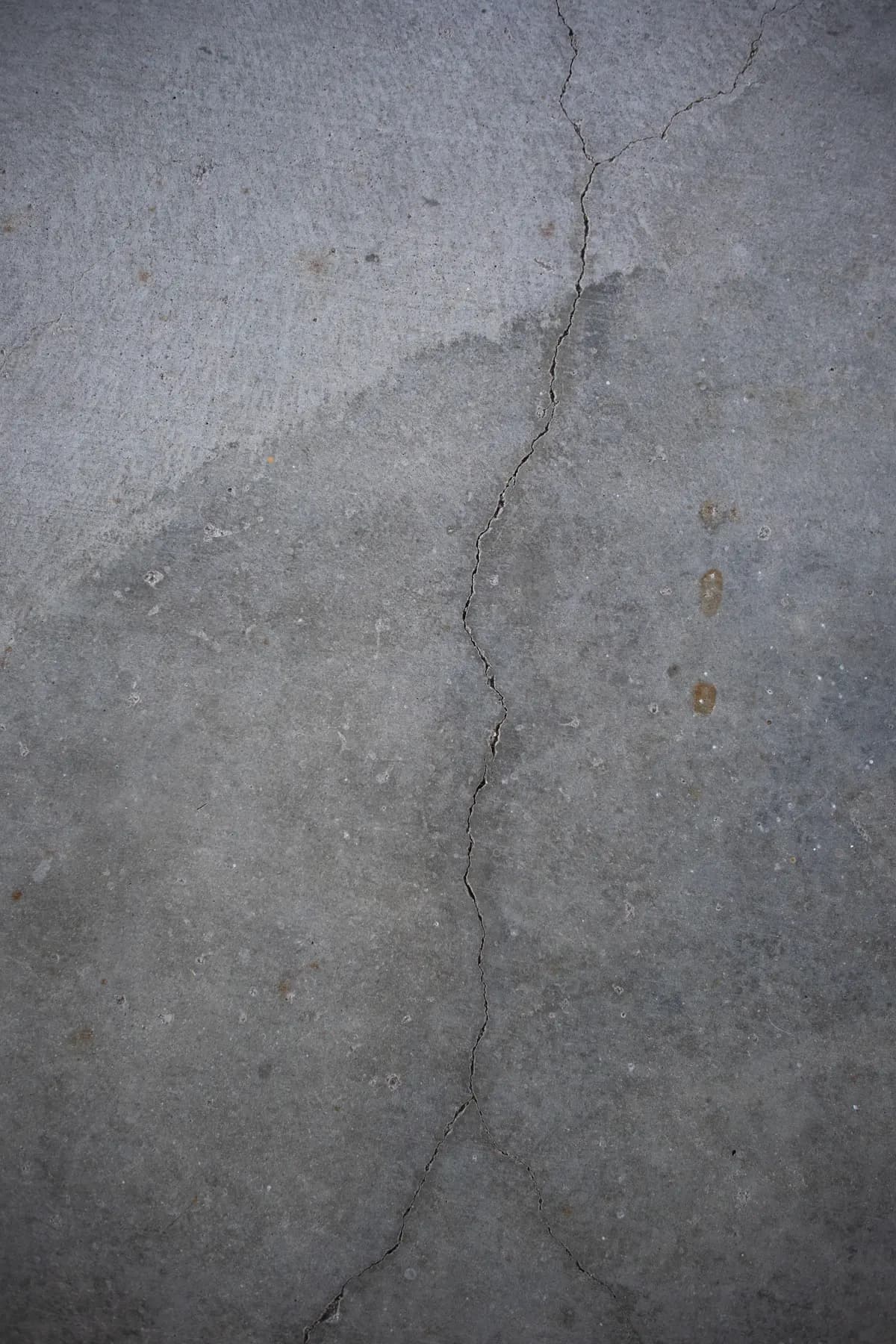
Each term unlocks a precise question. What concrete surface profile will your grinding achieve, and how will you verify it? Which moisture test will you use, and what result would change your recommendation? That question applies widely, since our analysis of the EIA's 2024 household survey finds 32.4% of occupied homes sit over a concrete slab. What is the solids content and thickness of each coat? Will the flake be a full broadcast? What topcoat is used, and does it include an anti-slip additive? How will you handle stem walls?
For tiles, ask about the rollover rating, point load guidance for lifts or jack stands, and how the tile handles drainage near a floor drain. For any system, ask what the warranty says about hot tire pickup and delamination. Installers who answer these questions clearly and in writing are easier to compare. The epoxy versus polyaspartic comparison and quiz put several of these terms into context.
Preparation terms, such as concrete surface profile, laitance and moisture tests, relate most directly to bond, and bond is what fails first on most garage coatings. Bob Vila notes water-based epoxy lasts only 1–3 years, a reminder that 100%-solids content and film thickness also matter; Angi lists 100%-solids resin at $45–$150 per gallon against $30–$50/gallon for water-based. Hello Garage's figure that tires can exceed 140°F explains why hot tire pickup appears in so many warranty exclusions.
Finish terms, such as flake broadcast and topcoat, matter for wear and appearance. Tile terms, such as rollover rating, matter for heavy use. If you remember only a few terms, make them concrete surface profile, moisture test, solids content and topcoat, because they cover most of what decides whether a coated floor lasts. The request form lets you ask for proposals that use them.
Homeowner polls
No votes yet. Yours will be the first. · saved on this device
No votes yet. Yours will be the first. · saved on this device
Concrete surface profile, or at least a clear description of mechanical grinding. It tells you how the slab will be prepared, which decides the bond. A proposal that specifies grinding to a stated profile is more reliable than one that says only surface prep or cleaning. Pair it with a named moisture test and result.
A mil is one thousandth of an inch, the standard unit for coating thickness. Proposals may give wet or dry film thickness for each coat. Dry film thickness is what remains after cure and is the more meaningful number. If a proposal gives no thickness, ask for it, because it is one of the few measurable ways to compare systems.
Pot life is the time a mixed resin stays workable before it begins to set. It is short for polyaspartic and longer for most epoxies, and it shortens further in heat. It matters because a crew must apply each batch within that window. Short pot life demands experienced installers and careful batch sizing.
The recoat window is the period after one coat is applied during which the next coat can bond chemically without extra sanding. If it is missed, the surface usually needs abrasion before recoating. Product data sheets state the window, and installers plan the schedule around it, especially in multi-coat systems.
A control joint is a groove cut or formed into the slab to guide where shrinkage cracks occur. In coating projects, installers decide whether to fill joints or honor them by leaving them open. Filling gives a seamless look but may crack along the joint later; leaving them open keeps the slab's movement pattern.
It is a fine grit, often aluminum oxide or polymer beads, mixed into or broadcast on the topcoat to add texture and grip. It reduces slipperiness when the floor is wet or oily. The amount affects feel and cleaning; more grit gives more traction but can make mopping harder.
Efflorescence is a white, powdery deposit of salts carried to the surface by moisture moving through the concrete. On a garage slab it is a sign of moisture movement and a reason to press for a moisture test before any bonded coating. It must be removed during preparation, and its cause should be understood first.
 Service guideEpoxy Garage Floor Coating
An epoxy garage floor coating is a two-part resin system applied in layers over ground, repaired concrete.
 Service guidePolyaspartic Floor Coating
A polyaspartic floor coating is an aliphatic polyurea system that cures within hours, resists UV yellowing, and tolerates lower application temperatures than epoxy.
 Service guideInterlocking Garage Tiles
Interlocking garage tiles are rigid or flexible modular pieces, usually 12 to 16 inches square, that snap together over the existing concrete without adhesive or curing.
 Service guideConcrete Grinding & Prep
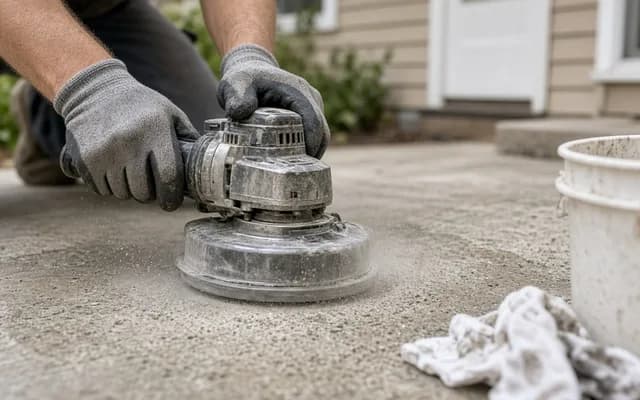
Concrete grinding and preparation means mechanically profiling a garage slab, removing old coatings and contamination, repairing cracks and spalls, and testing moisture so that a bonded coating can adhere.
 Free toolGarage floor cost calculator
Size, material tier and complexity in, a realistic budget range out.
 Free toolGarage floor comparisons
Side-by-side tables for the decisions that change the price most.
 Free toolWhich garage floor fits your slab and schedule?
8 questions that show what you already know and what to check next.
 Free toolGarage floor polls: how other homeowners decided
See what other planners chose and add your vote.
Tell us the size, the condition of what is there now, and what you want to change. Garage Floor Brief passes your request to independent local professionals, who reply with written, no-obligation estimates. The service is free to use.