Which garage floor did you choose, or are you leaning toward?
No votes yet. Yours will be the first. · saved on this device
Loading...
Garage Floor Brief · Materials
Garage floors fall into three families: bonded resin coatings such as epoxy and polyaspartic, loose-laid interlocking tiles, and roll-out mats. Within coatings, resin grade, film thickness, flake and topcoat matter as much as the chemistry. Tiles trade seams for zero cure time and easy replacement, and mats are a low-cost, short-lived cover rather than a finished floor.
By Garage Floor Brief editorial · Updated 2026-09-25
Product names on garage floor proposals can obscure more than they reveal. Two quotes that both say epoxy may describe a thin water-based paint and a thick 100%-solids system with a clear topcoat, which behave nothing alike. Polyaspartic is sometimes sold as polyurea, and interlocking tiles range from hollow economy squares to dense rigid tiles rated for aircraft hangars. The label is the least informative part of the specification.
This guide explains what each material actually is, how it bonds or sits on the concrete, how it responds to heat, chemicals and abrasion, and what its typical failure looks like. Figures come from Bob Vila, Angi, Garage Living, Garage Flooring LLC, Swisstrax, Hello Garage and FloorTek Coatings, with installer and manufacturer sources flagged. For cost detail, see the 2026 cost guide; this page is about how the materials perform.
Solids content is the share of the product that stays on the floor after it cures. A 100%-solids epoxy contains no water or solvent to evaporate, so a coat applied at a given thickness stays close to that thickness. Water-based products lose much of their wet film as water leaves, producing a much thinner layer. Bob Vila reports water-based epoxy lasting only 1–3 years, while 100%-solids products can last far longer when installed over properly prepared concrete.
Price reflects the difference. Angi lists 100%-solids resin at $45–$150 per gallon, with water-based resin at $30–$50/gallon and solvent-based at $40–$55/gallon. FloorTek Coatings, an installer that sells polyaspartic, estimates that professional epoxy shows significant problems after 3–5 years while DIY kits fail sooner. Treat that as an installer view, but the direction matches what homeowners report: thin films peel first.
Polyaspartic is an aliphatic polyurea, a family of coatings that cure quickly and resist yellowing in sunlight. Epoxy is an aromatic resin that cures slowly, builds thickness well and bonds strongly to properly profiled concrete, but tends to amber under UV exposure near an open garage door. Duration Concrete Coatings reports polyaspartic accepts foot traffic in about an hour and vehicles within 24 hours, while Garage Living says epoxy can take up to 7 days before parking.
Speed has a cost. Fast-curing polyaspartic gives the crew only minutes of working time, which demands experience, and it is harder to apply at thick builds in one pass. Many professional systems therefore combine the two: an epoxy base coat for build and bond, broadcast flake, and a polyaspartic clear topcoat for UV and abrasion resistance. Garage Living cites a 15–25 years service life for polyaspartic systems with proper maintenance. The epoxy versus polyaspartic comparison sets the trade-offs side by side.
Decorative flake is not just decoration. A full broadcast, where flake is scattered until the wet base coat is completely covered, adds texture, hides small slab imperfections and dirt, and creates a thicker composite layer once a clear topcoat locks it in. Partial broadcasts look lighter and cost less but leave more resin exposed. Galaxy Concrete Coatings' 2025 breakdown prices flake separately from base and topcoats, which is a useful sign that it is a distinct layer in the system. Stone-look pebble resin, which Angi lists at $100/gallon, is a different decorative route with its own build.
The topcoat carries most of the wear. It resists abrasion from tires and grit, takes the chemical hits from oil and brake fluid, and determines how slippery the floor feels when wet. Ask for the topcoat product by name and whether an anti-slip additive is included. Film thickness is usually stated in mils, thousandths of an inch; a proposal that gives no thickness for any coat leaves you with nothing to check if the floor wears through early.
Hot tire pickup is the failure most homeowners picture when they think of a peeling garage floor. Hello Garage explains that tires can exceed 140°F after a summer drive, which softens the coating as the rubber cools and contracts. If the bond to the concrete is weak or the film is thin, the tire lifts a patch of coating when the car pulls away. The underlying cause is almost always preparation and thickness rather than the weather itself.
Thicker, fully cured systems over mechanically ground concrete resist hot tire pickup far better than thin films over etched or dirty slabs. Polyaspartic topcoats handle heat and plasticizer migration from tires well, which is one reason installers recommend them in hot climates. Tiles avoid the problem entirely because nothing is bonded, although very soft flexible tiles can mark under hot tires. If your climate is hot, ask each installer specifically how their system prevents pickup.
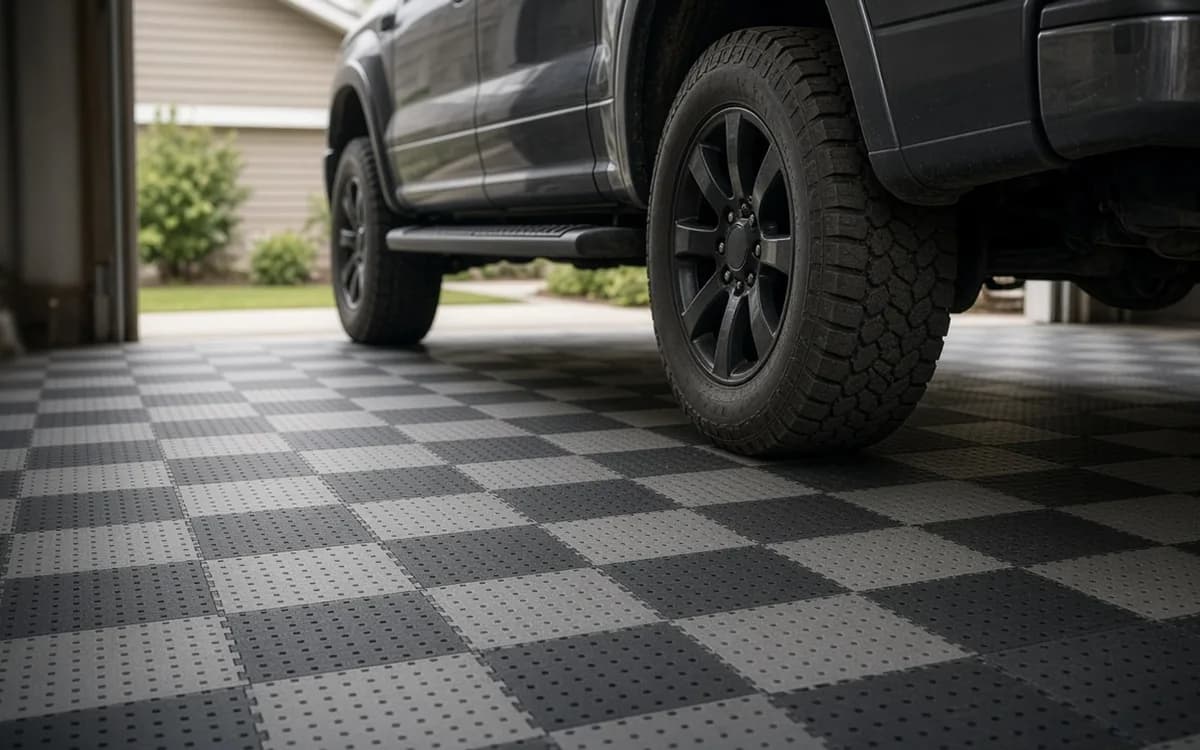
Most garage tiles are injection-molded polypropylene, either rigid with a vented or ribbed surface or solid with a coin or diamond pattern. Flexible PVC tiles are softer and quieter underfoot. Garage Flooring LLC prices interlocking tiles at $2.90–$8.00+ per sq ft in materials, and Swisstrax lists its branded tiles at $4.49–$7.75 per sq ft. The price gap mostly reflects tile density, thickness, locking design and UV stabilizers.
Load capacity is rarely the limiting factor for a residential garage. Swisstrax rates its Ribtrax Pro tile at 70,000 lbs rollover weight, far beyond any passenger car, lift post or jack stand. The practical concerns are different: seams that trap fine dust, drainage underneath vented tiles, sound when walking in hard shoes, and expansion in hot garages. The interlocking tiles page covers layout, edging and drainage in detail.
Roll-out mats are sheets of PVC or rubber that lie over the slab with no fastening. Garage Flooring LLC prices them at $1–$5 per sq ft, 2–10 years, making them the cheapest and shortest-lived option. They suit renters, parking-only bays, garages awaiting a slab repair, and owners who want to contain melting snow and road salt under the car without committing to a permanent floor.
Mats are not a finished floor. Water and grit can collect underneath, edges curl in cold weather, and they cover only part of the space unless seamed. They are best treated as a protective cover. If you are choosing between a mat and a tile system for a whole garage, the tiles versus mats comparison explains where each wins, including cleaning, lifespan and how each handles a drain or a sloped slab.
Grind and seal is exactly what it sounds like: the slab is diamond ground to remove weak surface paste and stains, then sealed with a penetrating or thin film sealer. It leaves a clean concrete look rather than a colored coating. It suits owners who want a tidier, dust-free floor for a modest outlay and are willing to reseal periodically, and it can be a sensible interim step when a coating is planned for later.
The trade-off is protection. A sealer does not build a thick wear layer, so oil and chemicals can still stain, and tires wear the surface over time. It also requires good grinding, since a sealer over dirty or weak concrete performs poorly. The concrete grinding and prep page covers grind and seal alongside preparation for full coatings, because the grinding step is the same for both.
For a garage you park in every day, a ground slab with a polyaspartic or polyaspartic-topped coating is the most durable choice on published lifespans; epoxy is the budget coating; tiles are best on a damp or cracked slab; paint and thin sealers are cosmetic. Rank the options by how you use the garage, not by price alone.
The ranking column in the table in this section is Garage Living's 2019 worst-to-best list, which places its own polyaspartic system at the top, so read it as one seller's order. The lifespan column adds the independent or differently interested figures this site uses elsewhere: Bob Vila for epoxy, Garage Flooring LLC for tiles and mats, and Homewyse for the cost of applying a sealer. Tiles are the disputed row. Garage Living ranks them in the middle and says they can shift or warp, while Garage Flooring LLC gives interlocking tiles $2.90–$8.00+ per sq ft in materials and a 10 to 25-plus year life; the coating versus tiles comparison sets out when each view holds.
| Option | Garage Living rank (7 = best) | Published lifespan | Best use |
|---|---|---|---|
| Basic floor paint | 1 | Months before chipping (Garage Living) | A quick cosmetic refresh where nothing is driven |
| Stain and thin decorative coatings | 2 | Not stated | Appearance only; little wear protection |
| DIY sealers, thin acrylic or latex | 3 | Reapply every 1–2 years (Garage Living) | Dust control; a sealer applied over ground concrete runs $1.49–$1.76 per sq ft (Homewyse, 2026) |
| Interlocking tiles and mats | 4 | Tiles 10–25+ years, mats 2–10 years (Garage Flooring LLC); disputed by Garage Living | Damp or cracked slabs, renters, garages that cannot be emptied |
| Concrete resurfacer alone | 5 | Not stated without a topcoat | A repair layer under a coating, not a finish |
| Epoxy | 6 | 5–10 years (Bob Vila); water-based kits 1–3 years | Storage and workshop garages, mild climates, tight budgets |
| Polyaspartic and polyurea hybrids | 7 | 15–25 years (Garage Living); over a decade (Bob Vila) | Daily parking, hot tires, sunny doors, cold-weather installs |
Homeowner polls
No votes yet. Yours will be the first. · saved on this device
No votes yet. Yours will be the first. · saved on this device
No votes yet. Yours will be the first. · saved on this device
Polyaspartic is a type of aliphatic polyurea, and many installers use the terms loosely. Traditional pure polyurea used in industrial spray applications cures in seconds and is rarely used in residential garages. When a proposal says polyurea, ask for the product name and data sheet so you know whether it is a polyaspartic or something else, and what its published cure times and thickness are.
Metallic epoxy uses pigments that swirl within the resin to create a marbled look. It is a decorative finish that usually has a smooth, glossy surface, so it can be more slippery when wet and shows scratches more readily than a textured flake floor. It also tends to be priced higher because of the extra artistry. Most homeowners choose it for show garages rather than working spaces.
A bonded coating with a chemical-resistant topcoat keeps salt out of the concrete, which is the main goal, and it wipes clean. Vented tiles let meltwater drain through but can leave salt residue on the slab underneath that needs periodic rinsing. Mats contain the water but can trap it. In snowbelt garages, a sloped floor to the door or a drain matters as much as the material.
Yes, for a sound coating. The existing surface is abraded, cleaned and recoated with a new topcoat, with or without flake. It is much cheaper than a full removal. A coating that is peeling or lifting cannot simply be recoated, because the new layer will fail along with the old one. An installer should test adhesion before quoting a recoat.
Yes. Vented and ribbed tiles drain water and give more grip, while smooth coin or diamond patterns can be slippery with wet shoes or oil. Flexible PVC tiles tend to feel less slippery underfoot than rigid polypropylene. If the garage is also a gym or kids' play area, ask for a sample tile and test it with wet shoes before ordering the whole floor.
Garage floor paint is a thin, often latex-based film that wears quickly under tires and is generally not a long-term floor. Acid or water-based concrete stain changes color but offers little protection unless sealed. Both can make sense for a lightly used garage or a tight budget, but neither should be priced or compared as if it were a resin coating system.
Sunlight entering a garage door yellows many epoxies over time, especially in the first few feet inside the door. Aliphatic topcoats such as polyaspartic resist that yellowing much better. If the door faces west or south and stays open often, ask for a UV-stable topcoat and a sample that has been exposed to sun, or consider a tile with UV stabilizers.
 Service guideEpoxy Garage Floor Coating
An epoxy garage floor coating is a two-part resin system applied in layers over ground, repaired concrete.
 Service guidePolyaspartic Floor Coating
A polyaspartic floor coating is an aliphatic polyurea system that cures within hours, resists UV yellowing, and tolerates lower application temperatures than epoxy.
 Service guideInterlocking Garage Tiles
Interlocking garage tiles are rigid or flexible modular pieces, usually 12 to 16 inches square, that snap together over the existing concrete without adhesive or curing.
 PlanningHow to plan a garage floor project from first look to final walk-through
Plan a garage floor by defining how the space is used, checking the slab for moisture, cracks and old coatings, deciding how long the garage can sit empty, and choosing a season that suits the chemistry.
 CostsGarage floor coating cost in 2026: every system, every garage size
A professionally coated two-car garage costs roughly $1,600 to $6,900 in 2026 according to Duration Concrete Coatings, with epoxy toward the low end and polyaspartic toward the high end.
PermitsDo you need a permit for a garage floor? Codes, inspections and HOA rulesA coating or tile floor laid over an existing garage slab usually needs no building permit, because it is treated as a surface finish.
 Free toolGarage floor cost calculator
Size, material tier and complexity in, a realistic budget range out.
 Free toolGarage floor comparisons
Side-by-side tables for the decisions that change the price most.
 Free toolWhich garage floor fits your slab and schedule?
8 questions that show what you already know and what to check next.
 Free toolGarage floor polls: how other homeowners decided
See what other planners chose and add your vote.
Tell us the size, the condition of what is there now, and what you want to change. Garage Floor Brief passes your request to independent local professionals, who reply with written, no-obligation estimates. The service is free to use.