How long can your garage stay empty for a floor project?
No votes yet. Yours will be the first. · saved on this device
Loading...
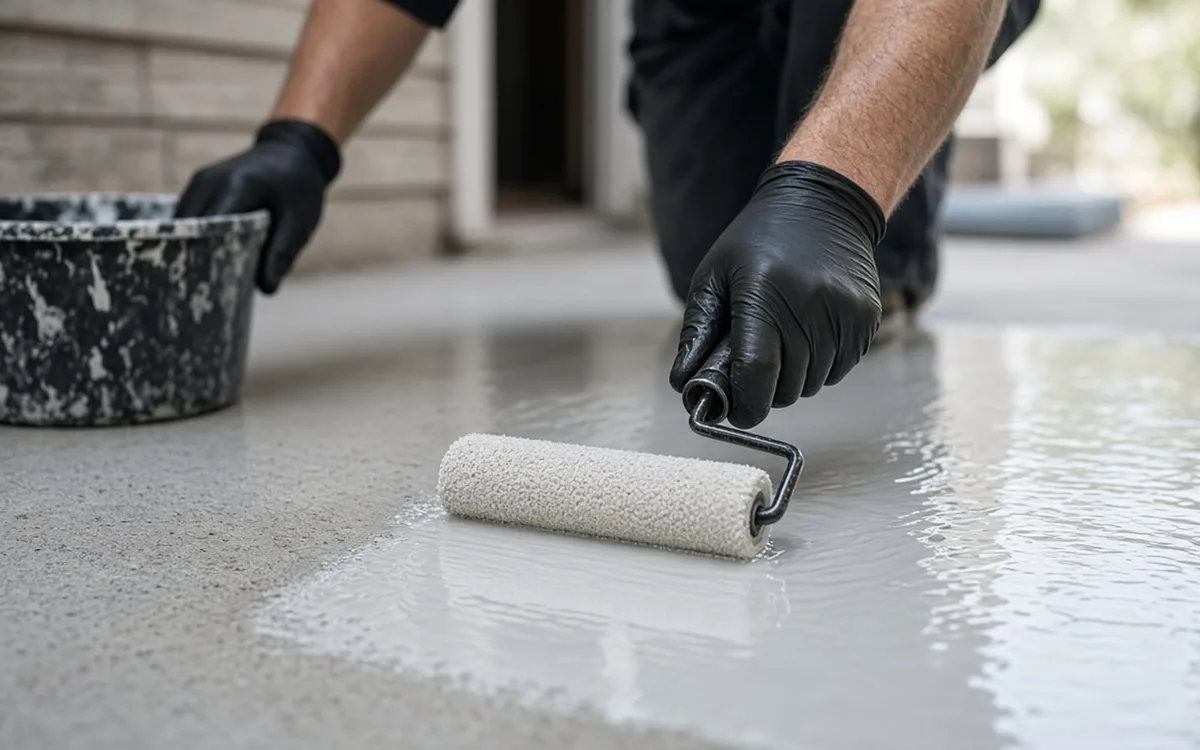
Garage Floor Brief · Service guide
A polyaspartic floor coating is an aliphatic polyurea system that cures within hours, resists UV yellowing, and tolerates lower application temperatures than epoxy. It fits homeowners who need to park within a day, who install in cold months, or who want the longest service life from a bonded coating. Expect $5 to $12 per square foot installed according to Duration's 2026 guide.
Polyaspartic is the coating installers now lead with, and the one-day pitch is the reason. Duration's 2026 guide lists foot traffic in about an hour and vehicles within 24 hours; Bob Vila's guide gives 3–6 hrs / 24 hrs for foot traffic and vehicles. Either way, the garage returns to use in a day rather than a week, and the finish holds its color at a sunny door where epoxy yellows.
The price is the trade. Duration puts installed polyaspartic at $5–$12 per sq ft versus $3 to $7 for epoxy, and Galaxy Concrete Coatings lists an $8 national average per square foot. This page covers what that premium buys, what the fast cure depends on, and the claims worth checking against a product data sheet before signing.
Want the numbers only? Read the polyaspartic floor coating cost guide for 2026 ranges, what moves the price, and sample budgets.
| Item | Low | High | Unit | Notes |
|---|---|---|---|---|
| Polyaspartic system, installed | $5 | $12 | per sq ft | Duration 2026; Bob Vila 2024 lists $4–$9 |
| Two-car garage polyaspartic project | $3,500 | $5,500 | flat | FloorTek 2025; HomeGuide 2026 lists $2,000–$6,900 |
| Labor share | $3 | $6 | per sq ft | Galaxy 2025 |
| Base coat material | $1.5 | $3 | per sq ft | Galaxy 2025 |
| Full flake broadcast | $0.5 | $1.5 | per sq ft | Galaxy 2025 |
| Moisture barrier or primer | $0.5 | $1 | per sq ft | Bob Vila 2024 |
| Surface grinding | $1 | $5 | per sq ft | Duration 2026 |
The clearest case is a daily-driver garage. If the cars have to be back inside tomorrow night, epoxy's several-day cure is a real cost in street parking and hassle, and polyaspartic's 24-hour return-to-vehicle-use erases it. Our analysis of the federal 2024 household survey found 32.0% of owner-occupied attached-garage homes also keep a second refrigerator out there, one more thing displaced for the cure. The second case is a cold-season install: polyaspartics cure at temperatures where epoxy stalls, which extends the installation season in the Midwest and Northeast. The third is a garage with a lot of daylight, where epoxy's UV yellowing would show within a few years.
It is a weaker case for a rarely used storage garage in a mild climate. There, epoxy at $3 to $7 per square foot does the same job, and the extra $2 to $5 per square foot buys speed you do not need. Bob Vila puts the national average epoxy garage floor project at $2,441, and a mixed system is the sensible way to save here: homeowners sometimes split the difference with an epoxy body coat and a polyaspartic topcoat, which keeps most of the UV and hot-tire benefit at a lower price. The epoxy versus polyaspartic comparison lays the two side by side.
A typical residential system is a polyaspartic or polyurea base coat, a full vinyl flake broadcast, and a clear polyaspartic topcoat. Galaxy breaks the materials down as base coat at $1.50 to $3.00 per square foot, flake at $0.50 to $1.50, and topcoat at $1.00 to $2.00, with labor at $3–$6 labor / $2–$6 materials per sq ft once everything is included. Some installers use a moisture-tolerant epoxy primer under the polyaspartic where slab vapor is a concern, which is a reasonable hybrid rather than a shortcut.
The chemistry has quirks the installer has to manage. Polyaspartics have a short pot life and go on thin, so they need an experienced crew moving fast; a thick pour does not self-level the way epoxy does. Humidity accelerates cure, which can trap bubbles or leave roller marks on a hot, wet day. The upside is the same fast reaction that makes a one-day install possible. Ask which products are used for each layer and read the temperature and humidity limits on the data sheet.
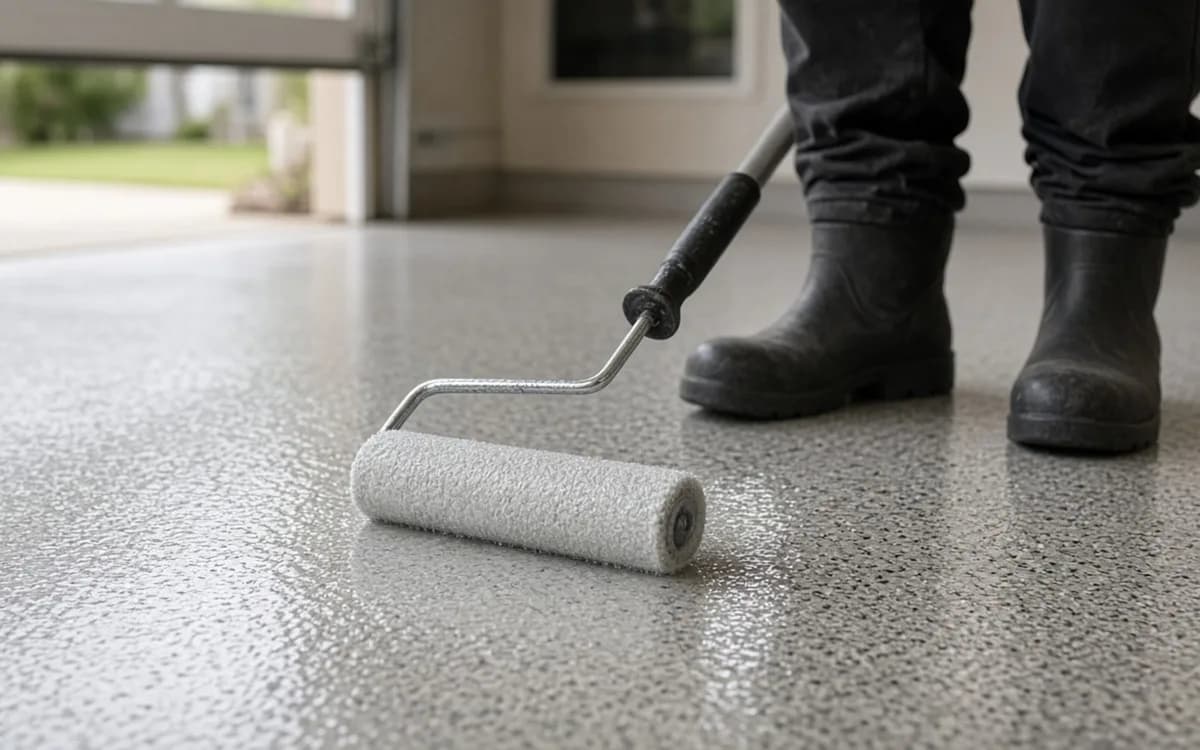
Bob Vila's 2024 guide lists $4–$9 per sq ft, or $2,000 to $4,500 for a 500-square-foot garage. Duration's 2026 guide is higher at $5 to $12, and HomeGuide's 2026 figure for a two-car garage is $2,000–$6,900. FloorTek's 2025 price guide quotes a two-car garage at $3,500–$5,500 vs $2,000–$4,000 for professional epoxy. The overlap in those ranges is mostly preparation and layer count, the same drivers as epoxy.
Regional pricing varies more than for most trades because a few franchised installers dominate some markets. Galaxy reports $6 to $10 per square foot in Indianapolis and $8 to $12 in Denver. Add-ons follow the same pattern as epoxy: grinding at $1–$5 per sq ft, moisture barrier at up to $1 per square foot per Bob Vila, and crack repair at $250 to $800. Use the calculator with the polyaspartic tier to see how those stack on your square footage.
| Source | Per sq ft | Two-car garage | Year |
|---|---|---|---|
| Bob Vila | $4–$9 | $2,000–$4,500 (500 sq ft) | 2024 |
| Duration Concrete Coatings | $5–$12 | $1,600–$6,900 (all coatings) | 2026 |
| Galaxy Concrete Coatings | $4–$12, $8 avg | Regional $6–$12 | 2025 |
| FloorTek Coatings | n/a | $3,500–$5,500 | 2025 |
| HomeGuide | $5–$12 | $2,000–$6,900 | 2026 |
It depends on the slab being ready. Grinding a two-car garage, filling cracks, and vacuuming takes most of a morning; base coat, flake, scrape, and topcoat fill the afternoon. That works when the slab is dry, sound, and free of old coatings. If the site visit finds a previous coating to remove, heavy oil contamination, or a moisture reading over the limit, the job becomes two days, or the installer adds a primer that needs its own cure. A one-day promise that survives those findings is a promise about a different garage.
It also depends on weather. Polyaspartics cure faster in heat and humidity, which shortens the working window; a crew that cannot keep a wet edge leaves lap marks. In cold weather they still cure, but the 24-hour drive-on figure assumes the temperatures on the data sheet. Get the walk-on, drive-on, and heavy-load dates written into the proposal with the temperature assumption beside them. Duration's ~1 hr / 24 hr figures are typical, not universal.
Garage Living's 2026 comparison cites a service life of 15–25 years with proper maintenance, and backs its own system with a 21-year limited warranty. Bob Vila says more than a decade when installed properly versus 5 to 10 years for epoxy. Those figures assume grinding, a passed moisture test, and a full-thickness topcoat; a polyaspartic rolled thin over acid-etched concrete fails the same way epoxy does.
When polyaspartic fails, it is usually delamination from moisture below or from a base coat that was not scraped flat after flake, leaving ridges where the topcoat is thin. Scratching from dragged steel is the everyday complaint, since polyaspartic topcoats are hard but not immune. UV yellowing is not a problem; that is the material's advantage. Ask the installer what their warranty says about moisture, and whether a moisture-mitigating primer is available if the slab is borderline.
Weekly dust mopping and a pH-neutral wash a few times a year keep the topcoat clear. Rinse road salt in spring. Avoid steel-bristle brooms and dragged steel edges; use felt pads under tool chests and jack stands. Small scratches can be buffed by a pro, and the topcoat can be recoated after a screening step, which is easier to do at year 10 than to grind everything off at year 15. Keep the product name and batch on file for that recoat.
The lifecycle argument is what installers lean on. Galaxy amortizes polyaspartic at about $200 per year over 20 years versus $375 for epoxy, and FloorTek estimates $3,500 over 20 years versus $6,000 for repeated cheap epoxy. Both come from companies that sell polyaspartic, so treat the numbers as an argument rather than a finding. It is an argument helped by Bob Vila's note that water-based epoxy lasts only 1–3 years, the cheap kind that drives repeat coatings. The arithmetic still favors the longer-lived coating if you plan to stay in the house.
Polyaspartic's cold tolerance makes it the practical winter coating in the Midwest and Northeast, where an unheated slab would stall epoxy. In the South and Southwest, its resistance to hot tire pickup is the draw; Hello Garage's 140°F tire figure is a Sun Belt problem more than a Minnesota one. In the humid Southeast, installers watch humidity for cure speed, and vapor-tolerant primers are more often specified. The regional planning notes cover slab and moisture differences by region.
Confirm the base coat is polyaspartic or polyurea, not an epoxy with a polyaspartic topcoat sold under the faster name; both are legitimate systems, but they should be priced and described as what they are. Look for the grinding method, moisture reading, crack repair, and stem wall height. Check that the schedule matches the data sheet and that the warranty covers workmanship for a term that reflects the 15-to-25-year life the material is sold on.
Then normalize price per square foot across proposals for the same measured floor. A $4,800 two-car quote and a $3,600 quote may be the same system with different prep, or different systems entirely. Use the request form to gather several written proposals, and ask each installer for a photo of a floor they installed at least five years ago.
Homeowner polls
No votes yet. Yours will be the first. · saved on this device
Duration's 2026 guide lists polyaspartic at $5–$12 per sq ft versus $3–$7 for epoxy.
No votes yet. Yours will be the first. · saved on this device
No votes yet. Yours will be the first. · saved on this device
 Service guideEpoxy Garage Floor Coating
An epoxy garage floor coating is a two-part resin system applied in layers over ground, repaired concrete.
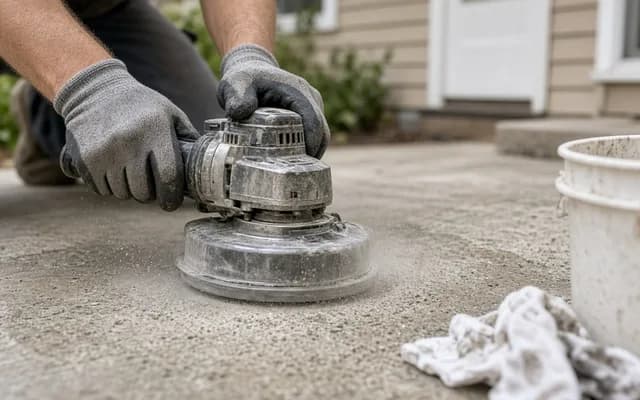 Service guideConcrete Grinding & Prep
Concrete grinding and preparation means mechanically profiling a garage slab, removing old coatings and contamination, repairing cracks and spalls, and testing moisture so that a bonded coating can adhere.
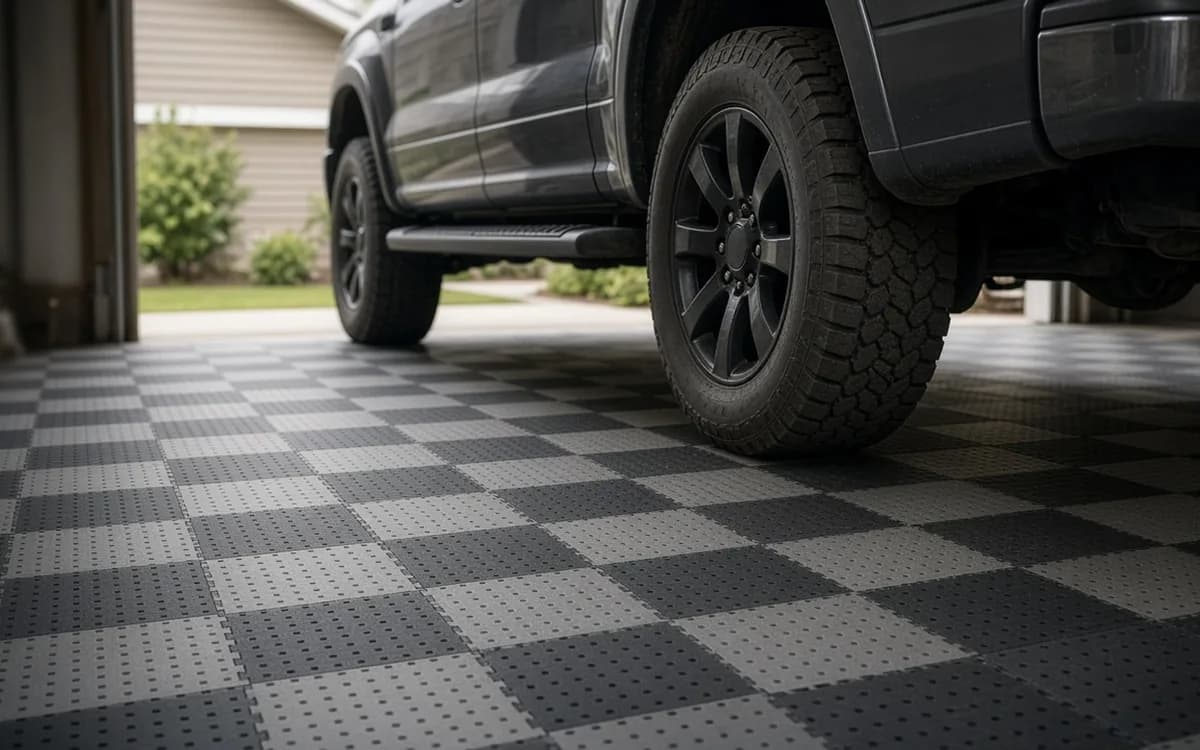
 Service guideInterlocking Garage Tiles
Interlocking garage tiles are rigid or flexible modular pieces, usually 12 to 16 inches square, that snap together over the existing concrete without adhesive or curing.
At the temperatures on the product data sheet, yes; Bob Vila and Duration both report 24 hours to vehicle traffic. In cold weather the window stretches, and full chemical cure takes longer than drive-on cure. Heavy point loads like a jack stand or a loaded tool chest should wait a few days. Ask for the drive-on date in writing with the assumed slab temperature.
Polyaspartic is a slower-reacting type of aliphatic polyurea developed to be roller-applied. Some installers use a fast-set polyurea base coat with a polyaspartic topcoat; others use polyaspartic for both. The labels overlap in marketing. What you want is the data sheet for each layer showing cure times, temperature limits, and recommended thickness, so you can check the schedule against it.
Less than epoxy. Polyaspartic goes on thin and follows the surface, so grinding marks, patched cracks, and trowel ridges can show through a solid color. A full flake broadcast hides almost all of it, which is one reason nearly every residential polyaspartic floor is flaked. If you want a smooth solid color, budget for more prep and a self-leveling epoxy body coat under the polyaspartic topcoat.
Not on its own. Polyaspartic is not a vapor barrier, and a slab that pushes moisture up will delaminate it as readily as epoxy. Installers address borderline slabs with a moisture-mitigating epoxy primer rated for high vapor emission, which adds cost and a day. A slab with standing water or active seepage needs drainage or a tile system, not a coating.
The polyaspartic topcoat is UV stable, so the clear coat will not yellow the way epoxy does. Vinyl flake pigments are also stable. Over many years, the sunlit strip inside the door may look slightly different from the back of the garage simply because it is cleaner and more worn, but it will not amber. This is the main visual advantage over an epoxy topcoat.
Galaxy's breakdown puts flake at $0.50 to $1.50 per square foot in material, plus the labor to broadcast, scrape, and vacuum it. On a 450-square-foot garage that is a few hundred dollars. Some installers price full flake as the standard and solid color as an upcharge because the solid finish demands more prep to look clean. Ask for both prices.
Neither is inherently better. Franchises bring standardized products and warranties; independent installers may offer more flexibility on scope and price. Judge both on the same criteria: grinding method, moisture testing, named products, written return-to-use dates, and a warranty that says who performs repairs. Ask either for a floor at least five years old that you can look at.
Rain itself is not the problem for an enclosed garage, but a spike in humidity accelerates polyaspartic cure and can cause bubbling or roller marks, and a wet driveway complicates grinding dust control. A careful installer reschedules or adjusts product choice. Ask upfront what weather conditions would postpone the job so a delay is not a surprise.
 Free toolGarage floor cost calculator
Size, material tier and complexity in, a realistic budget range out.
 Free toolGarage floor comparisons
Side-by-side tables for the decisions that change the price most.
 Free toolWhich garage floor fits your slab and schedule?
8 questions that show what you already know and what to check next.
 Free toolGarage floor polls: how other homeowners decided
See what other planners chose and add your vote.
Tell us the size, the condition of what is there now, and what you want to change. Garage Floor Brief passes your request to independent local professionals, who reply with written, no-obligation estimates. The service is free to use.