Have you had a garage coating fail before?
No votes yet. Yours will be the first. · saved on this device
Loading...
Garage Floor Brief · Service guide
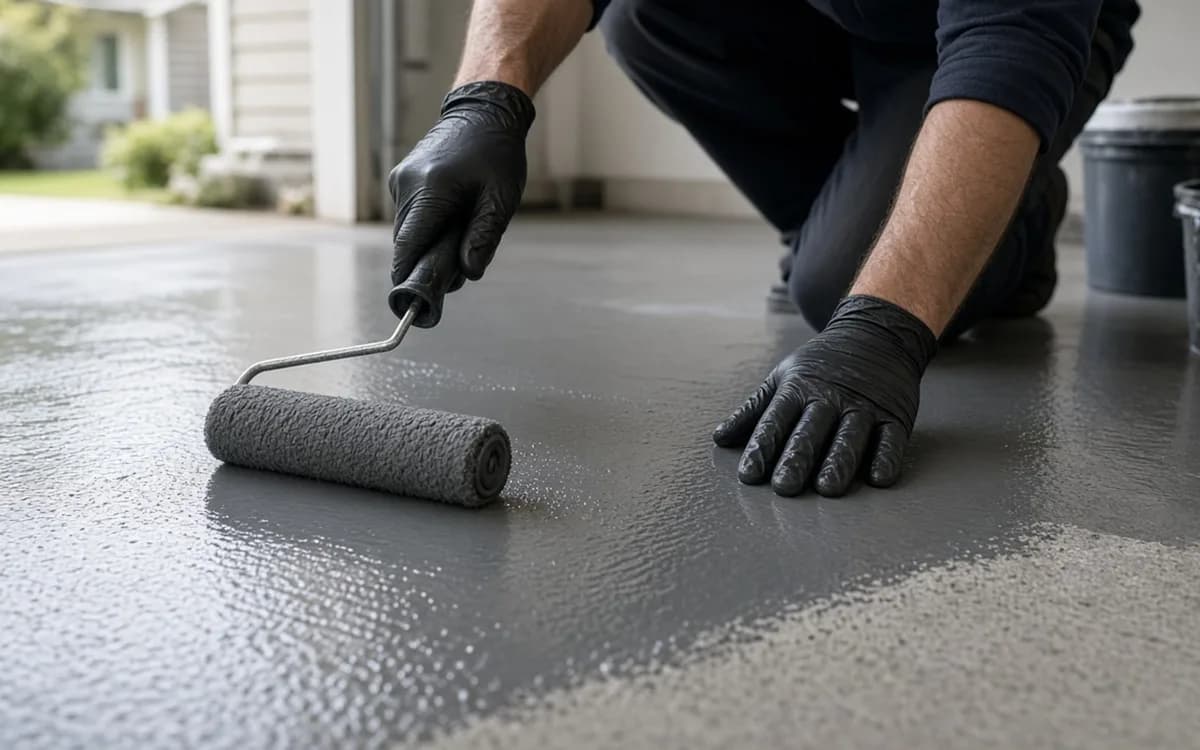
An epoxy garage floor coating is a two-part resin system applied in layers over ground, repaired concrete. It suits homeowners with a dry, sound slab who can keep vehicles out for several days and want a seamless surface at the lowest installed cost among bonded coatings, typically $3 to $7 per square foot for professional 100%-solids work according to Duration's 2026 guide.
Epoxy has been the default garage coating for decades, and its reputation is mixed for a reason: the same word covers a $40 hardware-store kit that peels in two summers and a professionally ground, multi-coat, 100%-solids system that lasts 15 years. Bob Vila's 2024 guide lists a national average of $2,441 for an epoxy garage floor project, with installed prices from $3 to $12 per square foot depending on prep, layers, and finish.
This page explains where that money goes, what a proper epoxy scope contains, and the failure modes to plan around. It assumes you have already decided on a bonded coating rather than tiles; if not, the comparison page settles that first.
Want the numbers only? Read the epoxy garage floor coating cost guide for 2026 ranges, what moves the price, and sample budgets.
| Item | Low | High | Unit | Notes |
|---|---|---|---|---|
| Professional 100%-solids epoxy, installed | $3 | $7 | per sq ft | Duration 2026; Angi 2026 lists $2–$12 across all epoxy types |
| Two-car garage epoxy project | $1,600 | $5,800 | flat | HomeGuide benchmark used by the calculator |
| Surface grinding and profiling | $1 | $5 | per sq ft | Duration 2026 |
| Old coating removal | $3 | $8 | per sq ft | Duration 2026 |
| Crack routing and repair | $250 | $800 | flat | Duration 2026 |
| Moisture testing | $200 | $500 | flat | Duration 2026 |
| Metallic epoxy finish | $5 | $12 | per sq ft | Bob Vila 2024 |
Epoxy makes the most sense in a garage that can be empty for a week and where the slab is dry and structurally quiet. Workshops, storage garages, and second garages that rarely see a warm tire are ideal. The resin builds thick, fills minor surface texture, and takes decorative flake well. It is also the least expensive professional coating: FloorTek's 2025 price guide puts a two-car professional epoxy job at $2,000 to $4,000, versus $3,500 to $5,500 for polyaspartic.
Skip epoxy, or at least choose a polyaspartic topcoat over it, if the garage is your daily parking spot in a hot climate. Hello Garage notes that tire temperatures can reach upward of 140°F, enough to soften an epoxy bond and cause hot tire pickup. Also skip it if the slab shows moisture: epoxy is less forgiving of vapor pressure than many alternatives, and a coating that lifts from below cannot be repaired by adding more on top. A moisture test settles this before you spend anything.
Angi's 2026 guide groups epoxy by solids content, and the categories map cleanly to lifespan. Water-based resin at $30–$50/gallon is the thinnest and shortest-lived; Bob Vila puts its life at 1–3 years. Solvent-based at $40–$55/gallon is a middle tier that is disappearing under VOC rules in many states. 100%-solids resin at $45–$150 per gallon builds the thickest film per coat and is what professional installers mean when they say epoxy; Angi's decorative pebble resin, at $100/gallon, is a separate stone-look product.
The system is more than the base coat. A typical professional build is a primer or moisture-tolerant base, a pigmented 100%-solids body coat, an optional vinyl flake or quartz broadcast for texture and appearance, and a clear topcoat. That topcoat is where many installers now use polyurethane or polyaspartic instead of epoxy, because epoxy yellows in sunlight and scratches more easily. Metallic epoxy finishes run $5 to $12 per square foot per Bob Vila and are a different skill set entirely.
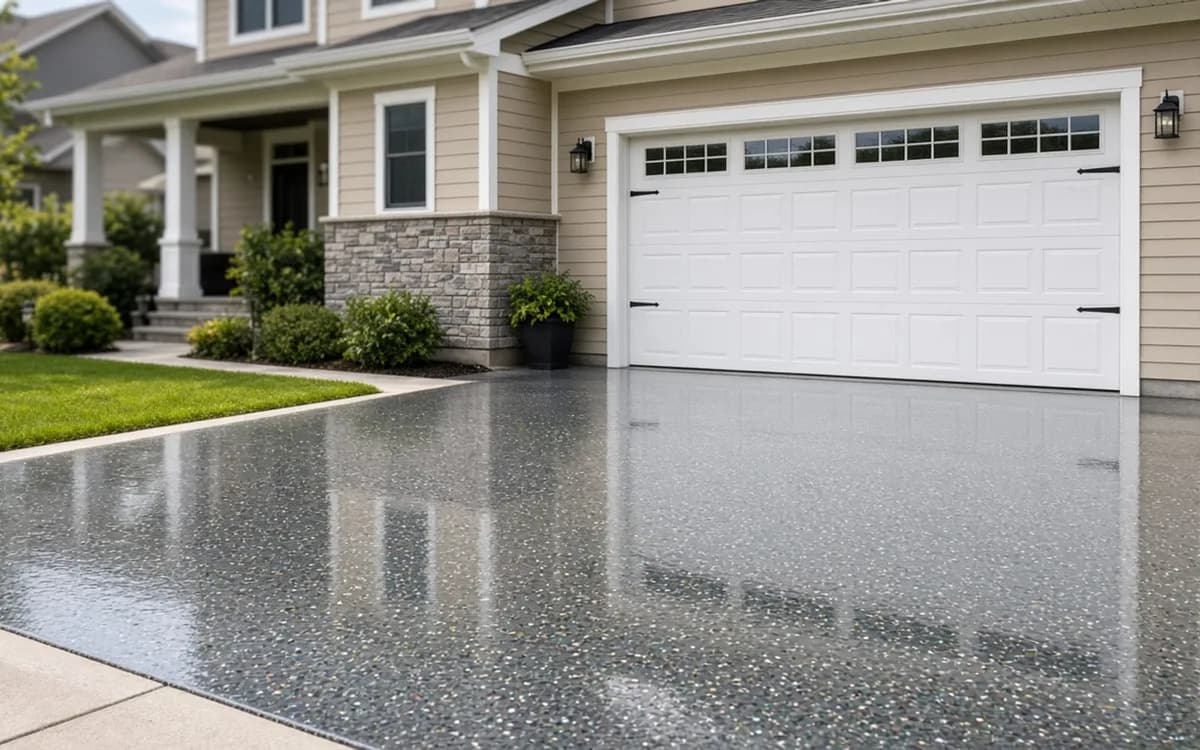
Square footage sets the base. Angi's size table lists $750–$3,000 for a 250-square-foot garage, $1,500–$6,000 for 500 square feet, and $2,250–$9,000 for 750. Bob Vila's ranges are tighter: $720 to $2,900 for a one-car garage and $1,100 to $4,300 for a two-car. HomeGuide, the benchmark used on this site's calculator, lists $1,600–$5,800 for a two-car epoxy installation.
Beneath the square-foot number, four things move a quote. Preparation is the biggest: Duration lists grinding and profiling at $1 to $5 per square foot, and removing a previous coating at $3 to $8. Repairs are second: crack routing and filling at $250 to $800, plus spall patching. Layer count is third: a two-coat system with a flake broadcast and clear topcoat costs materially more than a single pigmented coat. Edges are fourth: coating the stem walls to a 4-inch cove, finishing the door threshold, and treating expansion joints all add labor.
Labor is roughly $4 to $7 per square foot by Bob Vila's estimate, or $50 to $150 per hour, and Angi attributes 33–60% of the installed price to it. That is why the DIY material price of $1.45–$5.21 per sq ft from Garage Flooring LLC looks tempting and why DIY jobs fail: the savings come from skipping the grinding that makes the coating stick.
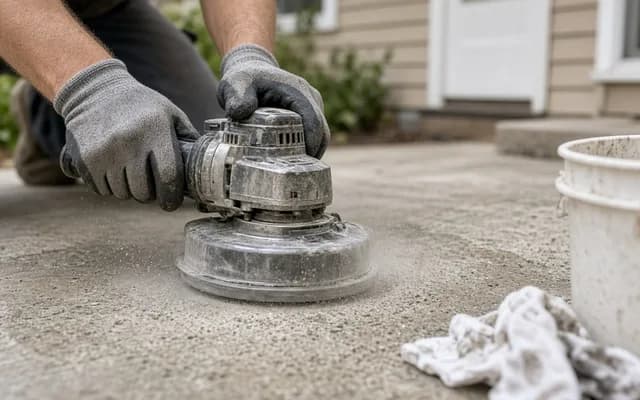
Day one is demolition and preparation. The garage is emptied, the slab is diamond ground with dust extraction to a surface profile the manufacturer specifies (CSP 2 to 3 for most epoxies), cracks are routed and filled with a rigid or semi-rigid filler, and any oil-soaked areas are degreased and reground. A moisture test is either read now or was taken at the site visit. If the slab fails the moisture limit, a moisture-mitigating primer is added or the project stops.
Day two is the base coat, sometimes with a primer the day before. Flake is broadcast into the wet body coat, allowed to set, then scraped flat. Day three is the clear topcoat. Duration lists epoxy at 12 to 16 hours before foot traffic and several days before parking; Garage Living's 2026 comparison says up to 7 days before vehicles. Full chemical resistance takes longer still, so keep gasoline and brake fluid off the floor for the period the data sheet states.
Weather matters. Most epoxies need the slab above roughly 50°F and humidity below the product's dew-point margin. A cold slab slows cure and can cause amine blush, a waxy film that ruins intercoat adhesion. Ask the installer how slab temperature will be measured and what happens if the forecast changes; polyaspartic is the usual answer for cold-season work.
Hot tire pickup fails first, and it fails at the parking spots, which is why a peeled epoxy floor almost always has two tire-shaped bald patches. The cause is heat softening a coating that was never mechanically anchored to the concrete. FloorTek Coatings, a polyaspartic installer with an obvious interest, still describes the typical timeline fairly: DIY water-based kits show problems in one to two years, and professional epoxy in 3–5 years when hot tires are part of the routine.
Moisture is second. A slab without a vapor barrier beneath it pushes water vapor upward, and an impermeable epoxy film traps it until blisters and delamination appear, often in the first spring. Third is UV yellowing near the door, cosmetic but obvious on light colors. Fourth is scratching from dragged tool chests and dropped tools, which a harder topcoat reduces. None of these are fixed by a thicker coat; all are addressed by prep, a moisture-tolerant primer, and the right topcoat chemistry.
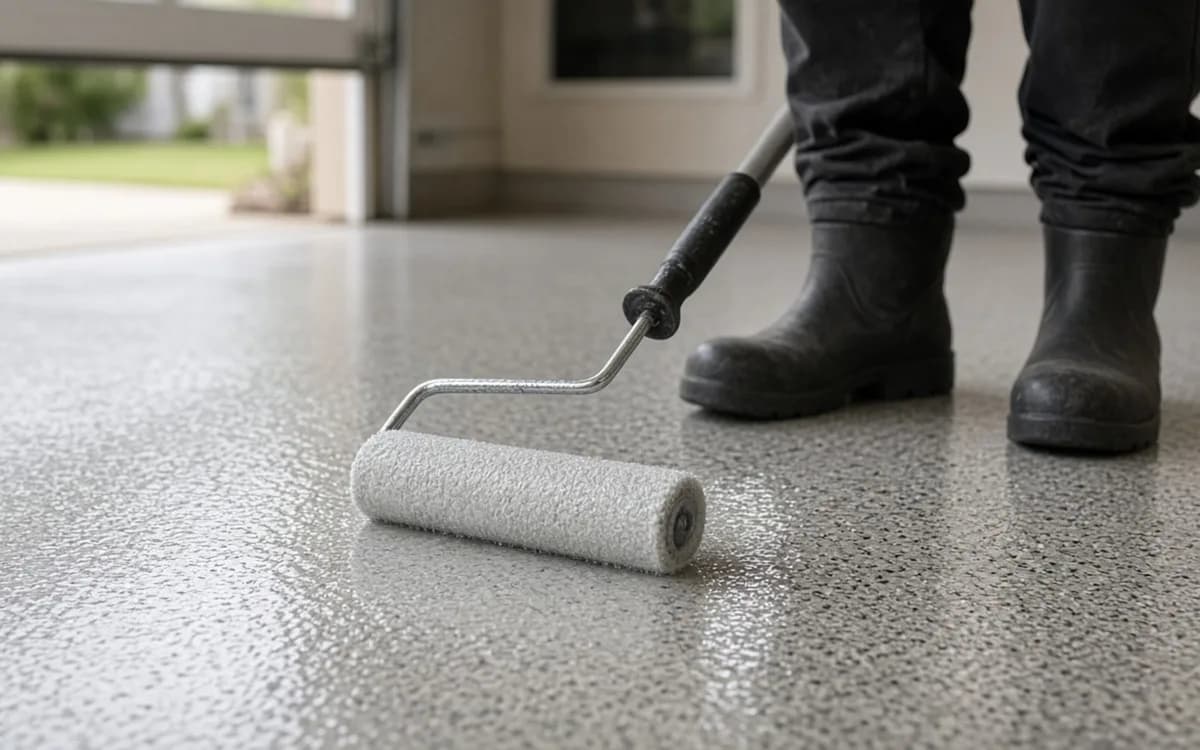
Maintenance is light, which is the point. Sweep or dust mop weekly, and wash with a pH-neutral cleaner and warm water a few times a year; avoid citrus degreasers and vinegar on a regular basis, as they dull the topcoat. Wipe oil and antifreeze promptly. In snow country, rinse salt and de-icer off in spring, because chloride residue is abrasive and mildly corrosive to some topcoats. Put a mat under the parking spots if you drive on it in summer and the topcoat is plain epoxy.
Expect to recoat the clear topcoat every five to ten years in a driven garage; Bob Vila estimates epoxy's overall life at 5 to 10 years versus more than a decade for polyaspartic. A recoat requires screening the surface for adhesion, so keep the product name and installer on file. A floor that has peeled to bare concrete in patches cannot be spot-recoated; the whole area needs regrinding.
Yes, more than most homeowners expect. In the South and Southwest, summer tire heat is the main risk, and a polyaspartic or urethane topcoat over the epoxy body coat is close to mandatory for a driven garage. In the Northeast and Midwest, the issue is winter installation: a cold, unheated slab may not cure epoxy at all between November and March, and road salt tracked in on tires needs rinsing. In humid Gulf Coast areas, slab vapor emission runs high and moisture-tolerant primers earn their cost.
Our analysis of the EIA's 2024 household survey finds 42.9% of occupied U.S. homes have an attached garage, ranging from 31.2% in the Northeast to 49.9% in the West, and 53.0% of owner-occupied attached-garage homes also report a slab foundation. The locations page breaks down what changes regionally. Regardless of region, the two questions that matter are the same: what did the moisture test read, and what is the topcoat?
Ask for the product data sheets for every layer, and check that the installer's stated cure and return-to-use dates match them. Confirm the prep method is grinding, not acid etching, and that the surface profile target is named. Look for a moisture reading with a number, a crack repair line item, and a note on how the stem walls and door threshold will be finished. Compare warranty length and exclusions; a warranty that excludes moisture and hot tire pickup on an epoxy floor is excluding the two ways it usually fails.
Then compare price per square foot for the same scope, not total against total. A $2,800 quote for a one-coat system with no grinding and a $4,200 quote for a ground, primed, two-coat system with a polyaspartic topcoat are not two prices for the same floor. Use the request form to get proposals from several matched professionals for the same measured area, and the reviews guide to check how their earlier floors held up.
Garage Floor Brief ran these numbers on the federal government's own household data. You won't find them in a contractor's brochure.
Garage Floor Brief analysis · 2024
95% interval 30.5%–33.5% · about 16.6 million homes · 7,070 survey households
About one in three homes with an attached garage keeps a second refrigerator there. Plan a dedicated outlet, a level pad and a floor coating that tolerates condensation where it will stand.
Source: Garage Floor Brief analysis of 2024 federal household survey data from the U.S. Energy Information Administration. How we calculated it
Homeowner polls
No votes yet. Yours will be the first. · saved on this device
No votes yet. Yours will be the first. · saved on this device
 Service guidePolyaspartic Floor Coating
A polyaspartic floor coating is an aliphatic polyurea system that cures within hours, resists UV yellowing, and tolerates lower application temperatures than epoxy.
 Service guideConcrete Grinding & Prep
Concrete grinding and preparation means mechanically profiling a garage slab, removing old coatings and contamination, repairing cracks and spalls, and testing moisture so that a bonded coating can adhere.
 Service guideInterlocking Garage Tiles
Interlocking garage tiles are rigid or flexible modular pieces, usually 12 to 16 inches square, that snap together over the existing concrete without adhesive or curing.
Most professional systems land between 20 and 40 mils total dry film across the primer, body coat, and topcoat, versus 3 to 5 mils for a hardware-store kit. Thickness alone is not the goal; it is a proxy for solids content and coat count. Ask the installer for the target dry film thickness of each layer and compare it with the product data sheet.
Only if the old coating is well bonded, fully cured, and compatible, and even then it must be sanded or screened for adhesion. Overcoating a peeling or unknown product transfers its failure to the new floor. Most installers recommend grinding a failed coating off completely, which Duration prices at $3 to $8 per square foot. A small adhesion test patch is cheap compared with redoing the garage.
A smooth, high-gloss epoxy can be slick when wet, especially at the door where snowmelt collects. Flake broadcast adds texture, and installers can add an anti-slip aggregate to the topcoat at a small cost. Ask for a sample with the texture you are considering and wet it. Slightly more grip makes the floor harder to squeegee, so pick the trade-off deliberately.
Acid etching uses diluted muriatic or citric acid to roughen the concrete surface chemically. It is what DIY kits recommend because it needs no equipment. It produces an inconsistent profile, leaves salts behind if not thoroughly rinsed, and does nothing for laitance or sealers. Diamond grinding produces a measurable profile and removes contamination, which is why professional proposals should specify it.
Yes, and it is one of the strongest reasons to coat. Dusting comes from a weak surface layer, often from overworked or over-watered concrete. Grinding removes that layer and the coating seals what remains. If the concrete is soft more than a fraction of an inch down, the installer may recommend a densifier before coating or a tile system instead.
Solid colors are the base price. A full flake broadcast adds material and the labor to scrape and topcoat it; Galaxy's cost breakdown for a comparable polyaspartic system puts flake at $0.50 to $1.50 per square foot. Partial or light flake is between. Metallic finishes are a separate technique at $5 to $12 per square foot per Bob Vila and vary in look from batch to batch.
Grinding, repairs, base coat, and topcoat in one day is not realistic for epoxy because each layer needs its recoat window. Installers who advertise one-day floors are using polyaspartic or polyurea, which is a different chemistry with a different price. If a proposal says epoxy and one day, ask which product and which data sheet supports that schedule.
A meaningful warranty covers delamination and adhesion failure from workmanship for at least several years, states who performs the repair, and lists exclusions plainly. Common exclusions are moisture vapor from below and hot tire pickup, which is exactly why a moisture test and a heat-resistant topcoat should be in the scope. A one-year warranty on a coating is close to no warranty.
 Free toolGarage floor cost calculator
Size, material tier and complexity in, a realistic budget range out.
 Free toolGarage floor comparisons
Side-by-side tables for the decisions that change the price most.
 Free toolWhich garage floor fits your slab and schedule?
8 questions that show what you already know and what to check next.
 Free toolGarage floor polls: how other homeowners decided
See what other planners chose and add your vote.
Tell us the size, the condition of what is there now, and what you want to change. Garage Floor Brief passes your request to independent local professionals, who reply with written, no-obligation estimates. The service is free to use.