What did you budget for a two-car garage floor?
Duration's 2026 national range for a coated two-car garage is $1,600–$6,900.
No votes yet. Yours will be the first. · saved on this device
Loading...
Garage Floor Brief · Costs
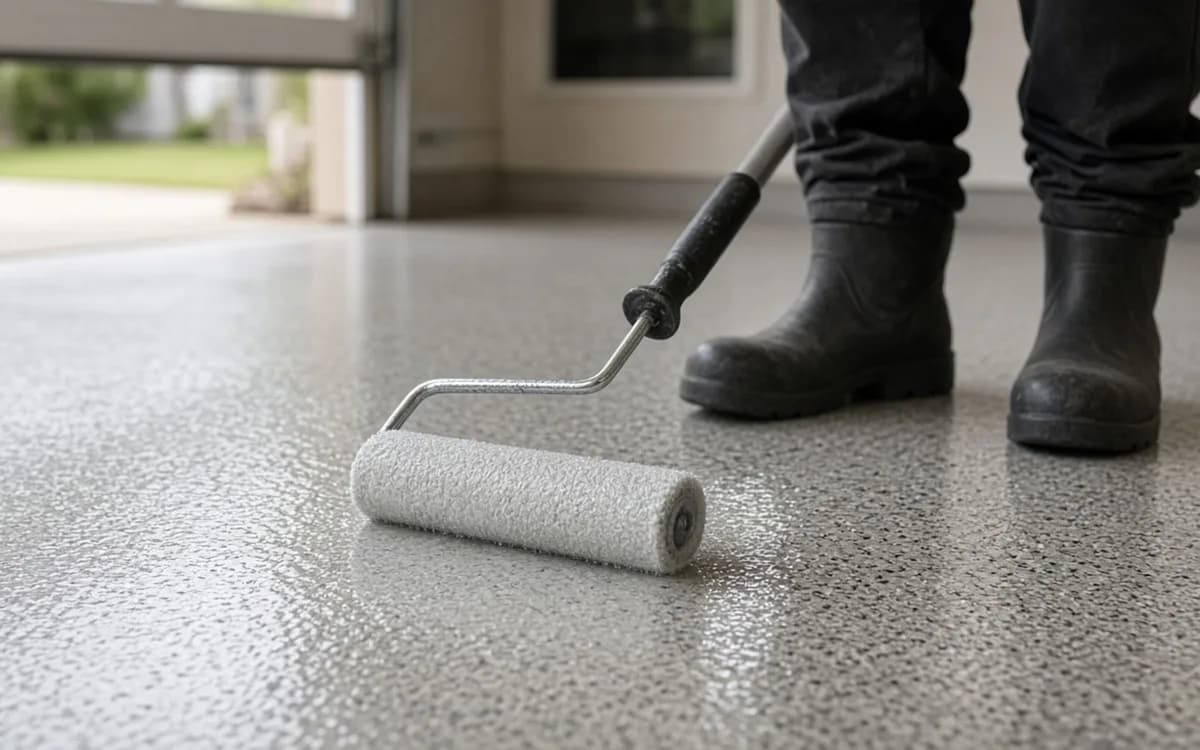
A professionally coated two-car garage costs roughly $1,600 to $6,900 in 2026 according to Duration Concrete Coatings, with epoxy toward the low end and polyaspartic toward the high end. Self-installed tiles for the same space run $800 to $2,900 per HomeGuide, and a sealer is cheaper still. Preparation, repairs and local labor explain most gaps between quotes.
By Garage Floor Brief editorial · Updated 2026-09-25
Garage floor prices look chaotic until you break them into parts. The same two-car garage can draw quotes that differ by a factor of three, and usually the difference is not the resin but what happens to the concrete before the resin goes down, how many coats are applied, and how much of the local labor market's overhead is baked into the price. Once you see the components, most quotes become explicable, and the ones that do not become easy to question.
This guide collects 2026 figures from Angi, HomeGuide, Duration Concrete Coatings and Bob Vila, plus installer-published comparisons labeled as such. It covers ranges by garage size and system, what pushes a price up or down, the labor and materials split, regional effects, the costs that surface mid-job, and how to read an itemized bid. The cost calculator uses the same sources if you want an estimate for your exact square footage.
Per-square-foot figures are the most comparable starting point. Angi's August 2026 update puts installed epoxy at $2–$12 per sq ft. Duration Concrete Coatings lists installed polyaspartic at $5–$12 per sq ft, while Bob Vila's 2024 guide gives a slightly lower $4–$9 per sq ft. Interlocking tiles cost $2.90–$8.00+ per sq ft in materials according to Garage Flooring LLC, and roll-out mats run $1–$5 per sq ft, 2–10 years. At the bottom of the scale, Homewyse's September 2026 estimate for applying a polyurethane sealer is $1.49–$1.76 per sq ft, before any grinding.
Those ranges are wide because each covers everything from a thin single coat to a multi-layer system over heavy repairs. The table on this page summarizes the published figures by system. Use it to place a quote in context, not to predict one. Your region, your slab and the number of coats specified will pull a real price toward one end or the other, and the rest of this guide explains which factors do the pulling.
| System | Published range | Source |
|---|---|---|
| Professional epoxy, installed | $2–$12 per sq ft | Angi, 2026 |
| Polyaspartic, installed | $5–$12 per sq ft | Duration, 2026 |
| Interlocking tiles, materials | $2.90–$8.00+ per sq ft | Garage Flooring LLC, 2025 |
| Roll-out mats, materials | $1–$5 per sq ft | Garage Flooring LLC, 2025 |
| DIY epoxy kit materials | $1.45–$5.21 per sq ft | Garage Flooring LLC, 2025 |
| Polyurethane sealer, applied | $1.49–$1.76 per sq ft | Homewyse, September 2026 |
Garage size is the biggest single multiplier, and the publishers do not agree on how big a garage is. Bob Vila's 2024 guides size a one-car garage at about 240 square feet and a two-car at 360, and price epoxy at $720–$2,900 and $1,100–$4,300 respectively, with three- and four-car garages at $1,700–$9,500. Duration's 2026 guide uses larger footprints, 400 to 576 square feet for two cars and about 864 for three, and gives national ranges of $1,600–$6,900 and $3,500–$10,400 across both coatings.
The table in this section lines the systems up by garage size. Epoxy figures are Bob Vila's epoxy guide (April 2024); polyaspartic figures are Bob Vila's polyaspartic size table (January 2024), which stops at 500 square feet, so the three-car cell multiplies its $4 to $9 per square foot by 864 square feet. The all-coatings column is Duration's 2026 national range. Tile figures are materials only: the two-car cell is HomeGuide's 2026 range for self-installed tiles, and the other two multiply Garage Flooring LLC's $2.90 to $8.00 per square foot by the size shown.
| Garage size | Epoxy, installed | Polyaspartic, installed | Any coating, installed (Duration) | Tiles, materials only |
|---|---|---|---|---|
| One-car (240–288 sq ft) | $720–$2,900 (240 sq ft) | $1,000–$2,250 (250 sq ft) | $1,200–$3,500 | About $700–$1,900 (240 sq ft) |
| Two-car (360–576 sq ft) | $1,100–$4,300 (360 sq ft) | $1,400–$3,150 (350 sq ft) to $2,000–$4,500 (500 sq ft) | $1,600–$6,900 | $800–$2,900 (HomeGuide, DIY) |
| Three-car (about 864 sq ft) | $1,700–$9,500 (three- to four-car) | About $3,450–$7,800 (864 sq ft × $4–$9) | $3,500–$10,400 | About $2,500–$6,900 (864 sq ft) |
The factors that raise a price are mostly about the concrete and the specification. Removing an old coating, grinding a hard or sealed slab, filling many cracks, treating a moisture problem, adding more coats or a thicker build, choosing metallic or custom designs, coating stem walls and steps, and working in a detached garage without power all add labor. Duration's 2026 guide adds $1–$5 per sq ft for surface preparation alone.
Labor is the larger share on most bonded coatings. Angi's 2026 guide says labor accounts for 33–60% of an installed epoxy floor price and puts epoxy labor at $1–$7 per sq ft. Galaxy Concrete Coatings' 2025 breakdown for polyaspartic lands at $3–$6 labor / $2–$6 materials per sq ft. Resin itself varies widely: Angi lists 100%-solids epoxy at $45–$150 per gallon, against $30–$50/gallon for water-based and $40–$55/gallon for solvent-based products.
The labor share explains why DIY looks so tempting. Garage Flooring LLC prices DIY epoxy materials at $1.45–$5.21 per sq ft, a fraction of installed prices. But most of the gap is grinding, repair and application skill, which is where DIY floors tend to fail. If you are weighing it, the professional versus DIY epoxy comparison covers equipment rental, product grade and the realistic lifespan of each route.
Labor rates, travel distances and climate all move prices by region. Galaxy Concrete Coatings' 2025 guide, which quotes local polyaspartic ranges, puts Indianapolis at six to ten dollars per square foot and Denver at eight to twelve. Large coastal metros with high labor costs usually sit at or above the top of national ranges, while smaller markets with several competing installers often come in lower. National figures are a midpoint, not a promise.
Garage size varies by region too, which changes totals even at the same unit price. NAHB's analysis of 2024 Census data shows three-car-plus garages at 15% of new homes nationally, with much higher shares in the West North Central states; by our count of Census new-home data, 154,000 homes completed in 2025 had three or more bays. In the existing stock, our analysis finds three-or-more-car attached garages on 6.0% of homes, from 9.4% in the West to 1.7% in the Northeast. The EIA's 2024 housing survey finds attached garages in 49.9% of occupied homes in the West against 31.2% in the Northeast. Hot-climate markets also see more demand for UV-stable topcoats.
The most common surprises are found under the surface. A clear sealer or old paint that nobody noticed turns a standard grind into coating removal. Cracks that looked cosmetic open up into wider, deeper repairs. Oil that has soaked deep needs extra cleaning or cutting out. And a moisture reading taken only after grinding can require a mitigating primer that was not in the price. Duration lists moisture testing at $200 to $500 and minor crack repair at $250 to $800.
Other extras sit outside the floor entirely: moving and storing contents, disposal of old coatings, temporary heat in a winter install, a generator for a detached garage, and sales tax on materials in states that charge it. Ask every installer how they price discovered conditions, whether as a fixed per-square-foot rate or per crack, and whether they will stop and call you before doing extra work. A written change-order rule protects you more than a low base price.
A useful bid names the preparation method and the concrete surface profile it will achieve, the moisture test type and result, each coat with its product name and target thickness, the flake coverage, the topcoat, what happens at stem walls and joints, cure times, and warranty terms including exclusions. A bid that says only epoxy floor, two-car garage, one price gives you nothing to compare and nothing to enforce if the floor fails early.
Lay the bids side by side and cost the missing items yourself. If one proposal includes moisture testing and crack repair while another does not, add the published allowances to the second before comparing totals. The cost pages for epoxy and polyaspartic show typical allowances for each line. When totals are adjusted this way, the apparently cheapest bid is often the most expensive one.
Annualizing the cost changes the ranking. Galaxy Concrete Coatings' 2025 guide works out polyaspartic at $200 vs $375 per year over twenty years, because it expects the more expensive system to last longer. Bob Vila notes that water-based epoxy lasts only 1–3 years, while 100%-solids products can last far longer. Both figures come with the usual caveat that installer-published lifespans assume good preparation and maintenance.
For tiles, the calculation is different again: no cure time, no recoats, and individual tiles can be replaced if damaged, but the upfront material cost is similar to a mid-range coating and the floor has seams. Whatever the system, the cheapest long-term option is usually the one whose preparation is done properly the first time, because recoating a failed floor means paying for removal on top of a second installation.
Homeowner polls
Duration's 2026 national range for a coated two-car garage is $1,600–$6,900.
No votes yet. Yours will be the first. · saved on this device
No votes yet. Yours will be the first. · saved on this device
No votes yet. Yours will be the first. · saved on this device
Usually because they are not quoting the same job. One may include grinding, crack repair, moisture testing and a clear topcoat, while the other assumes a clean slab and a single coat. Line the proposals up by component and add published allowances for anything missing. If the totals still differ widely after that, ask each installer to explain the difference in thickness and preparation.
It depends on the state and on how the installer invoices. Some states tax materials only, some tax the full installed price, and some treat the work as a real property improvement with different rules. Ask whether the total includes tax and how it was calculated, so you compare like with like between proposals from different companies.
A deposit to reserve a date and order materials is common. Many homeowners are comfortable with a modest share of the total up front and the balance on completion after a walk-through. Some states cap home improvement deposits by law, so check your state consumer protection office. Avoid paying the full amount before the floor is installed and inspected.
It can. Promotional financing with deferred interest can become expensive if the balance is not cleared before the promotion ends. Compare the total amount repaid, not the monthly figure. For a project that typically costs a few thousand dollars, many homeowners find that delaying a season to save is cheaper than financing, but it is a personal decision.
No publisher tracks a specific resale return for garage coatings. NAHB's regression on housing survey data finds a garage itself adds roughly 10 percent to home value, so keeping that space clean and usable supports what is already there. A tidy, sound floor helps in listing photos and showings, but budget for it as a use and maintenance decision rather than an investment.
Not necessarily. Franchises often use a single branded system and standard pricing, which can be higher or lower than local independents depending on the market. The more useful comparison is specification and warranty. A franchised proposal and an independent one should both list preparation, products, thickness and exclusions, and the one that does so more clearly is easier to evaluate.
Sometimes, but it is risky. Preparation is where most coating failures begin, and many installers will not warranty a floor they did not prepare. Emptying the garage, degreasing oil stains and removing loose debris are safe ways to save labor. Grinding and crack repair are best left to the crew that will apply the coating and stand behind the result.
 Service guideEpoxy Garage Floor Coating
An epoxy garage floor coating is a two-part resin system applied in layers over ground, repaired concrete.
 Service guidePolyaspartic Floor Coating
A polyaspartic floor coating is an aliphatic polyurea system that cures within hours, resists UV yellowing, and tolerates lower application temperatures than epoxy.
 Service guideInterlocking Garage Tiles
Interlocking garage tiles are rigid or flexible modular pieces, usually 12 to 16 inches square, that snap together over the existing concrete without adhesive or curing.
 Service guideConcrete Grinding & Prep
Concrete grinding and preparation means mechanically profiling a garage slab, removing old coatings and contamination, repairing cracks and spalls, and testing moisture so that a bonded coating can adhere.
 PlanningHow to plan a garage floor project from first look to final walk-through
Plan a garage floor by defining how the space is used, checking the slab for moisture, cracks and old coatings, deciding how long the garage can sit empty, and choosing a season that suits the chemistry.
MaterialsGarage floor materials: what each system is made of and how it failsGarage floors fall into three families: bonded resin coatings such as epoxy and polyaspartic, loose-laid interlocking tiles, and roll-out mats.
 PermitsDo you need a permit for a garage floor? Codes, inspections and HOA rules
A coating or tile floor laid over an existing garage slab usually needs no building permit, because it is treated as a surface finish.
 Free toolGarage floor cost calculator
Size, material tier and complexity in, a realistic budget range out.
 Free toolGarage floor comparisons
Side-by-side tables for the decisions that change the price most.
 Free toolWhich garage floor fits your slab and schedule?
8 questions that show what you already know and what to check next.
 Free toolGarage floor polls: how other homeowners decided
See what other planners chose and add your vote.
Tell us the size, the condition of what is there now, and what you want to change. Garage Floor Brief passes your request to independent local professionals, who reply with written, no-obligation estimates. The service is free to use.